
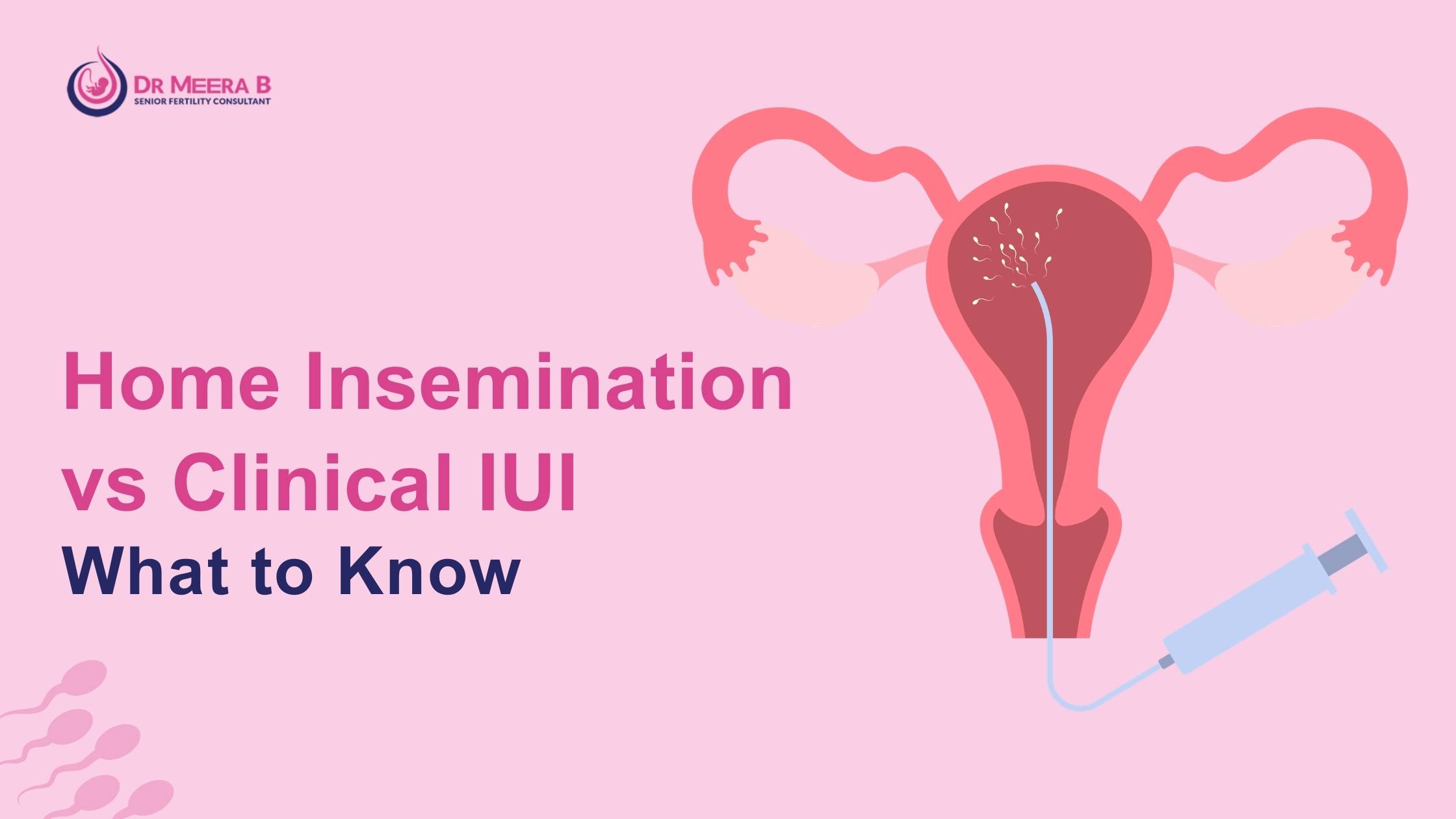
Home insemination vs Clinical IUI: What to Know
Did you know that intrauterine insemination (IUI) has an average success rate of approximately 10–20% per cycle in women under 35, depending on individual fertility factors? This widely cited public statistic highlights one critical truth: fertility outcomes depend heavily on proper evaluation, timing, and medical supervision. When couples compare home insemination with clinical IUI, understanding these differences can dramatically influence their journey toward parenthood.
If you are wondering whether insemination at home is enough—or whether you need structured fertility care—this detailed guide will help you make an informed, medically sound decision under the guidance of Dr Meera B, one of Kerala’s most experienced gynecologists and reproductive medicine specialists.
What is home insemination?
Home insemination refers to the placement of semen into the vagina outside a medical setting, typically using a syringe or similar device without laboratory sperm preparation or ultrasound monitoring.
This approach may be considered by couples facing mild timing challenges or by those using donor sperm. However, it is important to understand that home insemination is not the same as IUI performed in a clinical setting.
Common terms people search online
- insemination at home
- home iui insemination
- at home artificial insemination
- success rate of at home insemination
These search phrases often reflect confusion. Medically speaking, “home iui insemination” is not equivalent to clinical IUI because IUI requires laboratory sperm washing and placement directly into the uterus using sterile equipment under controlled conditions.
What is clinical IUI and how is it different?
Clinical IUI (Intrauterine Insemination) is a structured fertility procedure performed at Dr Meera B’s place of practice, currently including Aster PMF Hospital, Sasthamkotta. It involves ovulation monitoring, sperm processing, and carefully timed intrauterine placement.
Step-by-step process of clinical IUI
- Detailed fertility evaluation of both partners
- Ovulation tracking via ultrasound
- Hormonal support when medically indicated
- Sperm washing in a laboratory to concentrate motile sperm
- Direct placement into the uterus
- Luteal phase support when required
Unlike insemination at home, clinical IUI bypasses the cervical barrier and increases the number of motile sperm reaching the fallopian tubes, improving the probability of fertilization.
What is the success rate of at home insemination compared to IUI?
The success rate of at home insemination is generally lower than medically supervised IUI because it lacks sperm processing, uterine placement, and cycle monitoring. While exact percentages vary widely, home approaches rely heavily on natural fertility factors and perfect timing.
Clinical IUI, on the other hand, benefits from:
- Ultrasound-confirmed ovulation timing
- Processed, motile sperm concentration
- Medical optimization of uterine lining
- Infection control protocols
Dr Meera B emphasizes evidence-based protocols rather than assumptions. Her three decades of experience in obstetrics and reproductive medicine ensure that treatment recommendations are based on patient-specific fertility assessment—not guesswork.
Who should consider home insemination?
Home insemination may be considered in limited circumstances:
- Couples with no diagnosed fertility issues
- Regular ovulation confirmed
- No tubal blockage
- Normal semen parameters
However, without medical evaluation, underlying issues such as endometriosis, diminished ovarian reserve, or mild male factor infertility may go undetected—delaying appropriate treatment.
Why clinical supervision matters in fertility treatment
Fertility is a time-sensitive medical issue. Women are born with a finite number of eggs, and ovarian reserve naturally declines with age. Waiting too long while experimenting with unmonitored at home artificial insemination can reduce cumulative pregnancy chances.
Dr Meera B, MBBS, DGO, DNB(O&G), MRCOG(UK), FRCOG(UK), trained at the renowned Bourn Hall Clinic in Cambridge, brings international standards of reproductive medicine to Kollam. Her fellowship recognition in the UK reflects decades of clinical excellence.
At her place of practice, including Aster PMF Hospital, Sasthamkotta, patients benefit from:
- Advanced ultrasound facilities
- Hormonal profiling
- Reproductive endocrinology evaluation
- Evidence-based stimulation protocols
- Ethical fertility counseling
Risks of attempting insemination at home without guidance
While the concept of insemination at home may appear simple, potential risks include:
- Improper timing
- Introduction of infection
- Missed diagnosis of underlying infertility causes
- Emotional stress from repeated unsuccessful attempts
Dr Meera B strongly advises medical consultation before initiating any fertility approach. Even if a couple prefers a less invasive starting point, baseline evaluation ensures informed decision-making.
Comparative overview: Home insemination vs Clinical IUI
| Factor | Home insemination | Clinical IUI |
|---|---|---|
| Ovulation Monitoring | Often self-tracked | Ultrasound confirmed |
| Sperm Preparation | Unprocessed | Laboratory washed |
| Placement | Vaginal | Intrauterine |
| Infection Control | Variable | Medical standards |
| Medical Supervision | None | Specialist guided |
When should you consult Dr Meera B?
You should seek consultation if:
- You are under 35 and have tried for 12 months without success
- You are over 35 and have tried for 6 months
- You have irregular cycles
- You have known medical conditions affecting fertility
- You have concerns about the success rate of at home insemination
Early consultation prevents unnecessary emotional and financial strain. Fertility care is not just about procedures—it is about strategy, personalization, and timing.
About Dr Meera B
Dr Meera B is a senior gynecologist and reproductive medicine specialist based in Kerala. With qualifications including MBBS, DGO, DNB(O&G), MRCOG(UK), and FRCOG(UK), she has over thirty years of clinical experience. She completed her graduation from Govt Medical College, Trivandrum, and post-graduation at Govt Medical College, Kottayam.
Her advanced training at Bourn Hall Clinic in Cambridge—where the world’s first IVF baby was born—strengthened her expertise in assisted reproductive techniques. Today, she provides fertility consultations at her place of practice, including Aster PMF Hospital, Sasthamkotta, offering ethical, evidence-based fertility solutions to couples across Kollam and beyond.
Why couples in Kollam trust Dr Meera B
Choosing fertility care is deeply personal. Patients trust Dr Meera B because:
- She combines global training with local accessibility
- She practices ethical medicine without false guarantees
- She individualizes treatment protocols
- She prioritizes patient education and informed consent
Fertility decisions should not be based on internet trends like home iui insemination searches alone. They should be guided by experience, data, and compassionate care.
Take the next step toward parenthood
If you are debating between home insemination and clinical IUI, do not leave your future to uncertainty. A structured consultation can clarify your fertility potential and prevent avoidable delays.
To book an appointment with Dr Meera B:
- Fill out the consultation form at https://drmeerab.com/contact/
- Call +91 9447145101 to request scheduling
- Send a WhatsApp message through the website interface
Dr Meera’s team will schedule your appointment and guide you through the next steps. When it comes to building a family, informed choices today shape tomorrow’s possibilities. If you are in Kerala—especially Kollam—expert fertility care is within reach at Dr Meera B’s place of practice.
Home Insemination vs Clinical IUI: Frequently Asked Questions
home insemination involves placing sperm into the vagina without medical supervision, usually timed around ovulation. Clinical IUI, on the other hand, is performed in a fertility clinic where washed and concentrated sperm is inserted directly into the uterus under sterile conditions.
Under the care of Dr. Meera B, IUI includes ultrasound monitoring, hormone tracking, and lab preparation, offering greater precision and improved chances of conception compared to unmonitored methods.
insemination at home may be suitable for some individuals with no known fertility concerns. However, it does not include medical assessment, infection screening, or ovulation confirmation unless done separately.
Dr. Meera B recommends a fertility consultation before attempting at-home methods to ensure there are no underlying conditions that could reduce the chances of success.
home iui insemination is often used informally, but true intrauterine insemination requires medical expertise and sterile clinical preparation. Attempting uterine placement outside a clinical setting can carry health risks.
Clinical IUI performed by Dr. Meera B ensures safe catheter placement, proper sperm preparation, and monitored timing for better outcomes.
The success rate of at home insemination depends on age, egg quality, sperm health, and accurate timing. For younger individuals without fertility challenges, success may be possible but varies widely per cycle.
With clinical monitoring by Dr. Meera B, ovulation timing and sperm preparation are optimized, generally improving pregnancy rates compared to unmonitored attempts.
at home artificial insemination is sometimes chosen for privacy, cost considerations, or as an initial step before clinical intervention. It may be appropriate when there are no known reproductive health concerns.
If pregnancy does not occur after several cycles, consulting Dr. Meera B allows for diagnostic testing and structured treatment planning to avoid unnecessary delays.
If pregnancy has not occurred after 3–6 well-timed cycles, or earlier for women above 35, professional evaluation is advisable. Irregular cycles, endometriosis, PCOS, or male factor issues are strong reasons to seek medical care.
Dr. Meera B provides individualized IUI protocols tailored to each patient’s fertility profile, maximizing the likelihood of conception through evidence-based care.
Comments are closed