
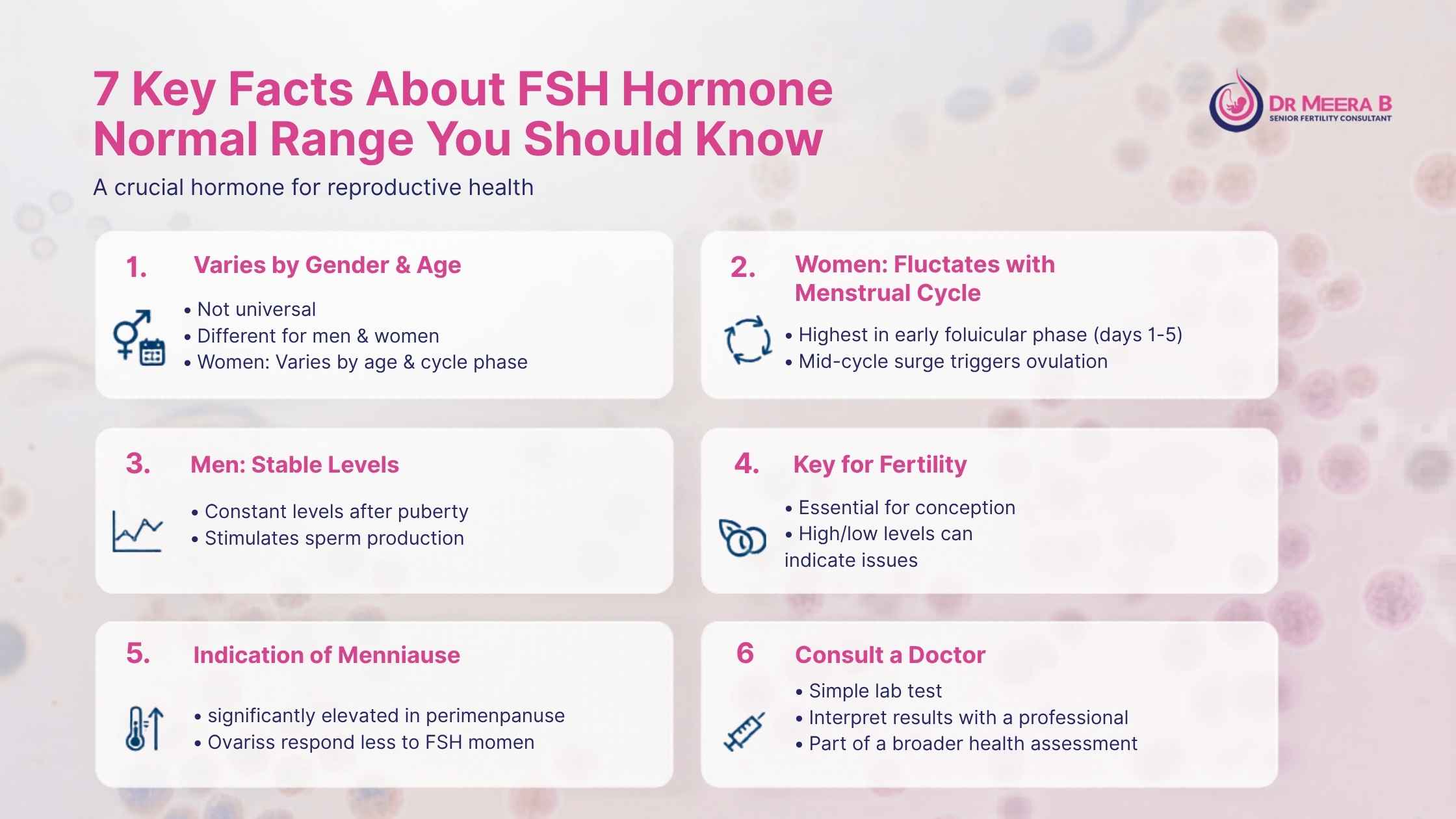
7 Key Facts About FSH Hormone Normal Range You Should Know
7 Key facts about FSH hormone normal range you should know
According to publicly available reproductive health data, nearly 30–40% of female infertility cases have a hormonal component, with follicle-stimulating hormone playing a central role in diagnosis and treatment planning. Understanding the fsh hormone normal range is therefore not just a laboratory curiosity—it is a critical step in making informed fertility decisions that can change the course of your reproductive journey.
Many individuals and couples delay fertility evaluation simply because hormone test results appear confusing or contradictory. This is precisely where expert interpretation matters. With more than three decades of clinical experience, Dr. Meera B brings clarity, precision, and ethical medical guidance to hormone evaluation and fertility care at Dr Meera B’s place of practice, including her current consultations at Aster PMF Hospital, Sasthamkotta.
What is FSH and why does its normal range matter?
Follicle-stimulating hormone (FSH) is a pituitary hormone essential for reproductive health in both women and men. In women, it stimulates the ovaries to produce follicles and mature eggs. In men, it supports sperm production. The interpretation of FSH values is always contextual, which is why knowing the fsh normal range alone is never sufficient without expert medical insight.
Dr. Meera B emphasizes that FSH values should be interpreted alongside age, menstrual cycle day, ultrasound findings, and other hormones such as LH and AMH. This integrated approach prevents unnecessary anxiety and ensures evidence-based decision-making.
Key fact 1: FSH levels vary with age and cycle timing
A concise answer: FSH levels are not static. They change based on age and the day of the menstrual cycle, which is why timing of the blood test is critical.
Typically, FSH is measured on day 2 or day 3 of the menstrual cycle for fertility evaluation. What is considered a normal fsh range for a woman in her late twenties may not apply to someone in her forties. Dr. Meera B ensures that test timing and age-specific interpretation are always followed, reducing misdiagnosis and overtreatment.
Key fact 2: Normal values do not always mean optimal fertility
A snippet-ready truth: Having an FSH value within reference limits does not automatically guarantee normal fertility.
Many patients are reassured by reports showing values within the normal range of fsh hormone, yet still struggle to conceive. This is because fertility depends on egg quality, ovarian reserve, tubal health, sperm parameters, and uterine factors. Dr. Meera B’s approach focuses on the whole reproductive picture rather than isolated numbers.
Key fact 3: High FSH levels can indicate reduced ovarian reserve
In simple terms: Elevated FSH may suggest that the ovaries are working harder to stimulate egg development.
Persistently high readings beyond accepted fsh normal ranges can be associated with diminished ovarian reserve, particularly in women above 35. Dr. Meera B carefully correlates these findings with ultrasound and AMH testing before advising next steps such as ovulation induction, IVF, or fertility preservation options available at her place of practice.
Key fact 4: Low FSH levels are also clinically significant
Low FSH is not always reassuring and can reflect pituitary or hypothalamic causes of infertility.
When levels fall below the expected normal range of fhs, it may point to stress-related hormonal suppression, excessive weight changes, or endocrine disorders. Dr. Meera B follows proven diagnostic pathways to identify reversible causes before considering advanced treatments.
Key fact 5: FSH interpretation differs for men and women
A direct answer: FSH reference values are sex-specific and should never be interpreted interchangeably.
In men, FSH reflects sperm production capacity. Elevated levels may indicate testicular dysfunction, while low levels may point to pituitary issues. Dr. Meera B’s fertility evaluations include both partners, reinforcing her belief that infertility is a shared medical concern requiring collaborative care.
Key fact 6: One test is never enough for fertility decisions
Clinically accurate guidance: A single FSH value should never be the sole basis for major fertility decisions.
Hormonal fluctuations, lab variations, and temporary stressors can influence results. Dr. Meera B relies on repeat testing and longitudinal assessment, a practice aligned with global reproductive medicine standards she mastered during her training at Bourn Hall Clinic, Cambridge.
Key fact 7: Expert guidance changes outcomes
The most important fact: Correct interpretation of FSH can significantly alter treatment outcomes.
Misinterpreting hormone values often leads to delayed care or inappropriate interventions. Under Dr. Meera B’s guidance, patients receive individualized, ethical, and evidence-based recommendations that maximize success while minimizing unnecessary emotional and financial strain.
Why consulting Dr. Meera B makes a difference
Dr. Meera B, MBBS, DGO, DNB (O&G), MRCOG (UK), FRCOG (UK), is a senior gynecologist and fertility specialist with over thirty years of experience. A graduate of Govt Medical College, Trivandrum, and post-graduate of Govt Medical College, Kottayam, she brings global expertise to local care in Kollam.
Her advanced training in Reproductive Medicine and IVF at the renowned Bourn Hall Clinic—birthplace of the world’s first IVF baby—ensures that every recommendation is grounded in proven science, not trends or false promises.
How to take the next step
If you are concerned about your hormone reports or fertility potential, delaying expert consultation may cost valuable time. At Dr Meera B’s place of practice, including Aster PMF Hospital, Sasthamkotta, patients receive comprehensive evaluations and clear guidance tailored to their goals.
To book an appointment, you may fill and submit the consultation form at
https://drmeerab.com/contact/,
call +91 9447145101, or send a WhatsApp message using the interface on the website. Dr. Meera’s team will schedule your appointment and keep you informed every step of the way.
Choosing expert guidance today can mean clarity, confidence, and better outcomes tomorrow. Missing this opportunity may mean losing precious reproductive time—something no report can ever replace.
Frequently Asked Questions
What does the fsh hormone normal range indicate about reproductive health?
The fsh hormone normal range provides insight into how effectively the brain, ovaries, or testes are communicating to regulate reproduction. When levels fall outside this range, it may point toward conditions such as ovarian reserve issues, pituitary imbalance, or testicular dysfunction. Dr. Meera B carefully correlates these values with symptoms, age, and menstrual or fertility history before recommending any treatment plan.
How is the fsh normal range different for women at various life stages?
The fsh normal range varies significantly depending on whether a woman is in her reproductive years, approaching perimenopause, or postmenopausal. Dr. Meera B interprets results in the context of cycle day, fertility goals, and hormonal balance, ensuring that patients receive guidance that is both accurate and individualized rather than based on numbers alone.
What is considered a normal fsh range for men, and why does it matter?
In men, the normal fsh range helps assess sperm production and overall testicular function. Abnormal values can be linked to infertility or hormonal disorders. Dr. Meera B uses these results alongside semen analysis and clinical evaluation to identify root causes and outline appropriate medical or lifestyle-based solutions.
Why is understanding the normal range of fsh hormone important before fertility treatment?
Knowing the normal range of fsh hormone is crucial before starting fertility treatments because it helps predict ovarian response and treatment outcomes. Dr. Meera B relies on this information to customize protocols, avoid unnecessary interventions, and improve the chances of safe and effective results for her patients.
Can fluctuating fsh normal ranges affect menstrual regularity?
Yes, changing fsh normal ranges can influence how regularly ovulation occurs, which in turn affects menstrual cycles. Dr. Meera B evaluates these fluctuations alongside ultrasound findings and other hormones to determine whether cycle irregularities are temporary or require targeted medical attention.
Is the normal range of fhs enough to diagnose a hormonal problem on its own?
The normal range of fhs alone is rarely sufficient for a complete diagnosis. Dr. Meera B emphasizes a holistic approach, combining laboratory values with clinical symptoms, imaging, and patient history to arrive at an accurate diagnosis and offer solutions that address the underlying cause rather than just the lab report.
Comments are closed