
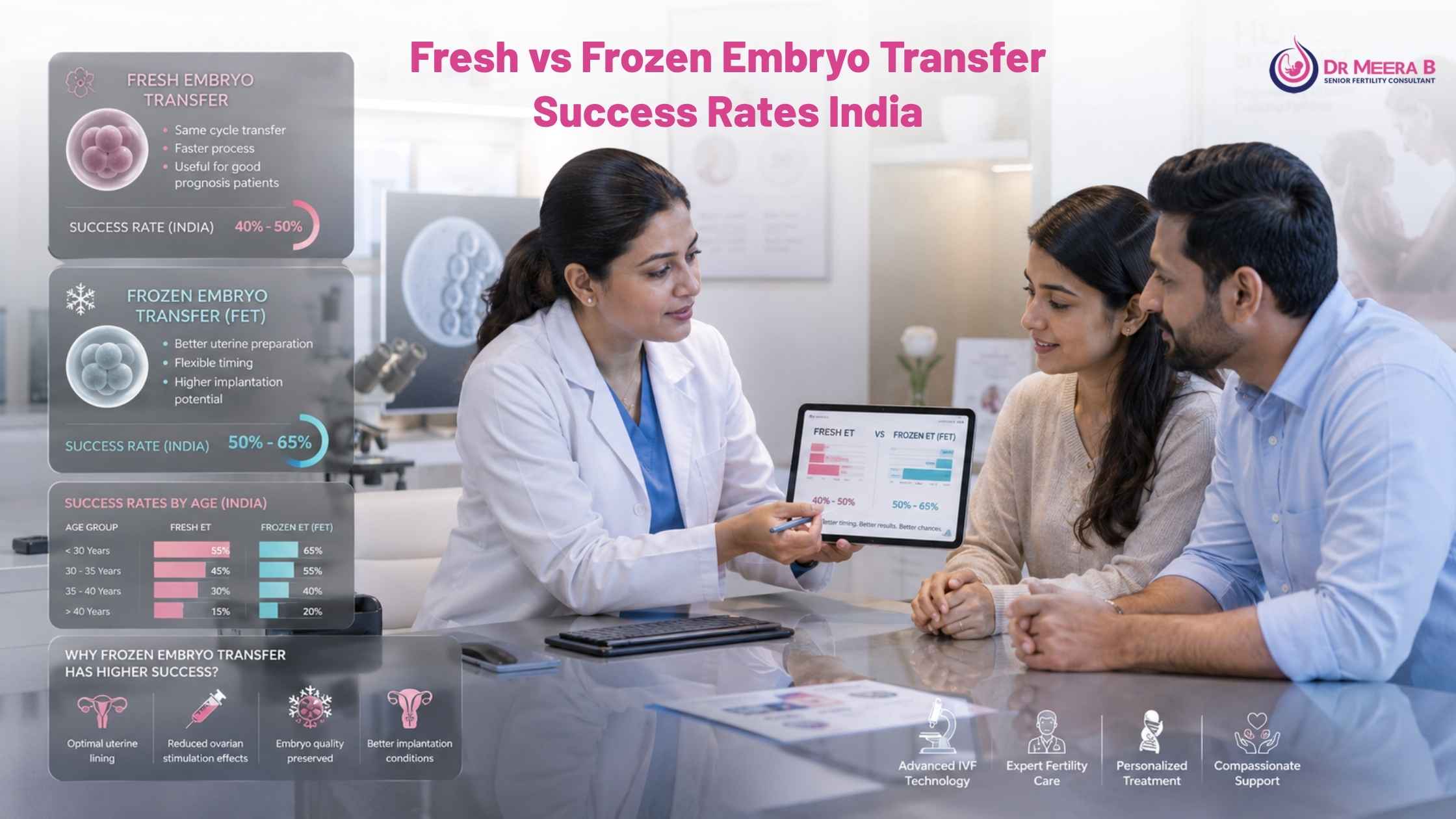
Fresh vs Frozen Embryo Transfer Success Rates India
In India, studies and clinical observations suggest that frozen embryo transfers (FET) may offer success rates that are equal to or even slightly higher than fresh transfers in certain patient groups, with implantation rates often ranging between 40%–60% depending on age and clinical factors. Understanding Fresh vs frozen embryo transfer success rates India is therefore crucial for couples seeking the best possible outcome from IVF treatment.
For many couples, the journey through infertility can feel overwhelming. The confusion around FET vs fresh IVF, combined with emotional stress and financial considerations, often leads to uncertainty about which path to take. This is where the expertise of Dr Meera B becomes invaluable—guiding patients with clarity, evidence-based care, and decades of experience in reproductive medicine.
What is the difference between fresh and frozen embryo transfer?
The key difference lies in timing and preparation. A fresh embryo transfer happens immediately after egg retrieval and fertilization, while a frozen embryo transfer involves freezing embryos and transferring them in a later cycle.
- Fresh embryo transfer: Performed within the same IVF cycle
- Frozen embryo transfer: Embryos are cryopreserved and transferred later
This distinction plays a critical role in IVF success comparison India, as uterine conditions, hormone levels, and patient health can significantly influence outcomes.
Why is frozen embryo transfer gaining popularity in India?
Frozen embryo transfer has become increasingly preferred due to improved cryopreservation techniques and better clinical outcomes in specific cases.
Some widely recognized frozen embryo transfer benefits include:
- Better synchronization between embryo and uterine lining
- Reduced risk of ovarian hyperstimulation syndrome (OHSS)
- Opportunity to optimize the uterine environment before transfer
- Flexibility in scheduling the transfer cycle
At Dr Meera B’s place of practice, including Aster PMF Hospital, Sasthamkotta, these advanced fertility treatment methods are carefully implemented to ensure patient safety and improved outcomes.
How do success rates compare in FET vs fresh IVF?
When evaluating FET vs fresh IVF, it is important to understand that success rates depend on multiple factors including age, embryo quality, and uterine health.
| Factor | Fresh Embryo Transfer | Frozen Embryo Transfer |
|---|---|---|
| Hormonal balance | May be affected by stimulation | More controlled environment |
| Endometrial receptivity | Variable | Optimized |
| Success rates | Good | Often equal or slightly higher |
This IVF success comparison India highlights why many fertility specialists now recommend frozen cycles in appropriate cases.
What factors influence embryo transfer success?
Success in IVF is never based on a single factor. Instead, a combination of clinical precision and patient-specific planning determines the outcome.
Key influencing factors include:
- Age of the woman
- Quality of embryos
- Endometrial thickness and receptivity
- Underlying medical conditions
- Laboratory standards and protocols
Dr Meera B emphasizes individualized care, ensuring that each patient receives tailored fertility treatment methods suited to their unique medical profile.
What are the available embryo transfer options?
Couples today have multiple embryo transfer options depending on their clinical condition and fertility goals.
- Fresh embryo transfer
- Frozen embryo transfer (FET)
- Single embryo transfer (SET)
- Multiple embryo transfer (in select cases)
Choosing the right option requires careful evaluation. At Dr Meera B’s place of practice, patients are guided through every step with transparency and scientific clarity.
How does the IVF procedure guide help patients prepare?
An effective IVF procedure guide helps patients understand each stage of treatment, reducing anxiety and improving compliance.
The IVF journey typically includes:
- Ovarian stimulation
- Egg retrieval
- Fertilization in the lab
- Embryo culture
- Embryo transfer (fresh or frozen)
With over three decades of experience, Dr Meera B ensures that patients are not just treated, but educated and empowered throughout the process.
Why choosing the right specialist matters
The difference between uncertainty and confidence often lies in the expertise of the specialist guiding your journey. Infertility is not just a medical condition—it is an emotional experience that requires compassionate, ethical, and evidence-based care.
Dr Meera B, with qualifications including MBBS, DGO, DNB(O&G), MRCOG(UK), and FRCOG(UK), brings global expertise to local care in Kollam. Her training at the renowned Bourn Hall Clinic in Cambridge—where the world’s first IVF baby was born—adds depth to her approach in reproductive medicine.
Patients consulting her benefit from:
- Personalized treatment strategies
- Access to advanced reproductive technologies
- Ethical and transparent medical advice
- Continuous support throughout the fertility journey
How to decide between fresh and frozen embryo transfer?
The choice between fresh and frozen transfer is not one-size-fits-all. It depends on clinical indicators and patient-specific factors.
Situations where frozen transfer may be preferred:
- High risk of OHSS
- Elevated hormone levels
- Need for genetic testing
- Suboptimal uterine conditions
Situations where fresh transfer may be considered:
- Good ovarian response
- Optimal hormone levels
- Favorable uterine lining
This nuanced decision-making process is where Dr Meera B’s expertise ensures patients do not miss out on the best possible outcome.
About Dr Meera B
Dr Meera B is a highly respected gynecologist and fertility specialist based in Kollam, Kerala, with over 30 years of experience. She specializes in reproductive medicine and IVF, offering advanced fertility treatment methods to couples both in India and internationally.
She consults at multiple leading healthcare institutions, including Aster PMF Hospital, Sasthamkotta, where patients have access to state-of-the-art fertility technologies and care protocols.
Take the next step toward parenthood
Every delay in seeking the right guidance can reduce the chances of success. With evolving advancements in IVF and increasing success rates in frozen cycles, understanding your options is more important than ever.
To consult Dr Meera B:
- Fill out the form: https://drmeerab.com/contact/
- Call: +91 9447145101
- Send a WhatsApp message via the website interface
Dr Meera’s team will schedule your appointment and guide you through the next steps.
Frequently Asked Questions
What are Fresh vs frozen embryo transfer success rates India?
Fresh vs frozen embryo transfer success rates India can vary based on patient age, embryo quality, and uterine conditions. In many cases, frozen embryo transfers are now showing equal or even higher success rates compared to fresh cycles. Dr. Meera B evaluates each case individually to recommend the most suitable approach for better implantation outcomes and long-term pregnancy success.
How does FET vs fresh IVF differ in outcomes and approach?
When comparing FET vs fresh IVF, the main difference lies in timing and hormonal environment. Fresh IVF transfers occur immediately after egg retrieval, while frozen embryo transfer allows the body to recover and prepares the uterus more naturally. Dr. Meera B often recommends frozen cycles when hormonal levels need stabilization for better implantation.
What are the key frozen embryo transfer benefits?
Frozen embryo transfer benefits include improved uterine receptivity, reduced risk of ovarian hyperstimulation, and flexibility in scheduling. It also allows genetic testing of embryos before transfer. Under Dr. Meera B’s guidance, patients benefit from a more controlled and optimized transfer environment.
How does IVF success comparison India help in choosing the right method?
IVF success comparison India provides valuable insights into clinic performance, techniques used, and patient outcomes. Dr. Meera B emphasizes that success rates should always be interpreted alongside individual health factors, rather than relying solely on generalized statistics.
What embryo transfer options are available for patients?
There are multiple embryo transfer options including fresh transfer, frozen transfer, and blastocyst transfer. Each option is selected based on embryo development and uterine readiness. Dr. Meera B carefully tailors these options to suit each patient’s fertility profile.
Can you explain the IVF procedure guide for beginners?
A complete IVF procedure guide includes ovarian stimulation, egg retrieval, fertilization, embryo culture, and embryo transfer. Dr. Meera B ensures that patients are well-informed at every step, making the journey transparent and less stressful.
What fertility treatment methods are recommended for different cases?
Various fertility treatment methods include ovulation induction, IUI, IVF, and ICSI. The choice depends on factors like age, infertility cause, and prior treatment history. Dr. Meera B adopts a personalized approach to recommend the most effective method for each patient.
Which option is better for me: fresh or frozen embryo transfer?
The choice between fresh and frozen embryo transfer depends on your medical condition, hormone levels, and embryo quality. Dr. Meera B conducts detailed evaluations to determine whether a fresh cycle or a frozen transfer will provide the best chance of success in your case.
Comments are closed