
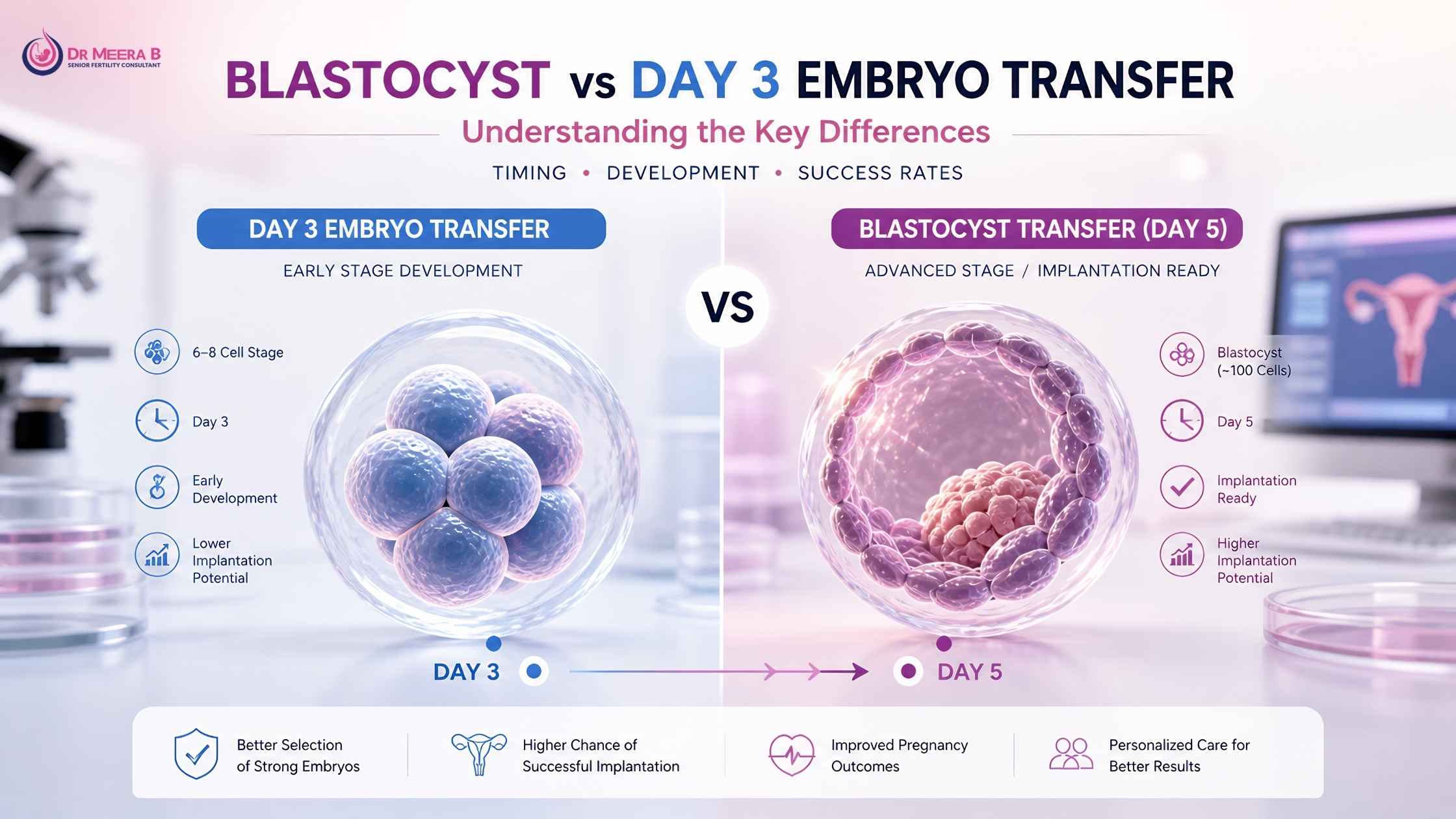
Blastocyst Transfer vs Day 3 Embryo Transfer: Which Is Better?
According to widely published IVF data, transferring embryos at the blastocyst stage can improve implantation rates by up to 50–60% in selected patients compared to earlier transfers. This makes the debate around blastocyst transfer vs day 3 embryo transfer one of the most important decisions couples face during IVF treatment.
For couples navigating fertility challenges, choosing the right embryo transfer timing is not just a medical decision—it’s an emotional and financial investment. Under the expert guidance of Dr Meera B, a highly experienced fertility specialist practicing at Aster PMF Hospital, Sasthamkotta, patients receive personalized, evidence-based care tailored to their unique reproductive journey.
What is blastocyst transfer and how does it work?
Blastocyst transfer refers to transferring an embryo into the uterus on the fifth or sixth day after fertilization. By this stage, the embryo has developed into a more advanced structure with differentiated cells, increasing its chances of successful implantation.
This stage corresponds to embryos day 5 development, where the embryo forms a fluid-filled cavity and begins to resemble its natural state at the time it would normally reach the uterus.
Key advantages of blastocyst transfer
- Higher implantation potential due to advanced development
- Better selection of viable embryos
- Closer alignment with natural implantation timing
- Reduced risk of multiple pregnancies when single embryo transfer is used
What is embryo transfer on day 3?
Embryo transfer on day 3 involves placing the embryo into the uterus when it is still in the cleavage stage, typically consisting of 6–8 cells. This method has been used for decades and remains a valid approach in many cases.
Understanding ivf embryo development stages helps explain this process. On day 3, embryos are still undergoing rapid cell division but have not yet reached the blastocyst stage.
Benefits of day 3 embryo transfer
- Suitable when fewer embryos are available
- Lower risk of embryo loss in laboratory conditions
- May be recommended for certain medical profiles
Day 3 embryo transfer vs day 5: What is the difference?
The comparison of day 3 embryo transfer vs day 5 primarily lies in embryo maturity, implantation potential, and selection accuracy.
| Factor | Day 3 Transfer | Day 5 Transfer (Blastocyst) |
|---|---|---|
| Development Stage | Cleavage stage (6–8 cells) | Blastocyst stage |
| Selection Accuracy | Limited | Higher |
| Implantation Rate | Moderate | Higher in suitable patients |
| Lab Dependency | Lower | Higher |
This embryo transfer stage comparison highlights that while blastocyst transfer may offer improved success rates, it is not universally better for every patient.
Blastocyst implantation timeline explained
The blastocyst implantation timeline typically begins within 1–2 days after transfer. The embryo attaches to the uterine lining and continues development, eventually leading to pregnancy if conditions are favorable.
This precise synchronization between embryo development and uterine receptivity is one reason why 5 day embryo transfer is often preferred in modern IVF practices.
Which option is better for you?
The answer depends on multiple factors, including age, embryo quality, previous IVF outcomes, and overall reproductive health. There is no one-size-fits-all answer when comparing blastocyst transfer vs day 3 embryo transfer.
Dr Meera B emphasizes individualized treatment planning, ensuring that every decision is guided by clinical evidence rather than assumptions. Her approach is rooted in decades of experience and advanced reproductive training, including expertise gained at globally recognized institutions.
Factors influencing the decision
- Number and quality of embryos available
- Patient age and ovarian reserve
- Previous IVF cycle outcomes
- Laboratory capabilities at Dr Meera B’s place of practice
Why expert guidance makes all the difference
Choosing between embryo transfer on day 3 and blastocyst transfer is not just about statistics—it’s about precision medicine. Without proper guidance, couples risk choosing an approach that may not align with their specific fertility profile.
This is where Dr Meera B’s expertise becomes invaluable. With over 30 years of experience and advanced training in reproductive medicine, she provides clarity in complex decisions, ensuring patients feel confident and informed.
Advanced IVF care at Dr Meera B’s place of practice
At Aster PMF Hospital, Sasthamkotta, patients benefit from access to modern IVF technologies and protocols. The focus is on maximizing success while maintaining ethical, evidence-based care.
Dr Meera B works closely with patients to:
- Assess embryo development accurately
- Determine optimal transfer timing
- Improve implantation outcomes through personalized care
The emotional and practical impact of your choice
Fertility treatment is not just a medical journey—it is deeply emotional. Choosing the right transfer method can significantly impact not only success rates but also the overall experience.
Delaying the right decision or choosing without expert consultation can lead to repeated cycles, increased costs, and emotional strain. On the other hand, a well-guided approach can bring clarity, efficiency, and hope.
Take the next step toward parenthood
If you are considering IVF and are unsure whether blastocyst transfer or embryo transfer on day 3 is right for you, now is the time to seek expert advice.
To book an appointment for consultation with Dr Meera B:
- Fill out the form at https://drmeerab.com/contact/
- Call +91 9447145101 to schedule your appointment
- Send a WhatsApp message through the website interface
Dr Meera B’s team will assist you in scheduling and guide you through the next steps of your fertility journey.
About Dr Meera B
Dr Meera B is a highly respected gynecologist and fertility specialist based in Kollam, Kerala. She holds MBBS, DGO, DNB (O&G), MRCOG (UK), and FRCOG (UK) qualifications, reflecting her extensive expertise and global training.
With over three decades of experience, she specializes in reproductive medicine and IVF. Her training at Bourn Hall Clinic in Cambridge, UK—the birthplace of IVF—adds to her distinguished profile. Patients trust her for her ethical approach, personalized care, and commitment to excellence.
Frequently Asked Questions
What is the difference between blastocyst transfer and embryo transfer on day 3?
The main difference between blastocyst transfer and embryo transfer on day 3 lies in timing and development. In embryo transfer on day 3, the embryo is transferred earlier when it has fewer cells. In contrast, blastocyst transfer happens later, typically as a 5 day embryo transfer, when the embryo has reached a more advanced stage and is better prepared for implantation.
How does day 3 embryo transfer vs day 5 impact success rates?
When comparing day 3 embryo transfer vs day 5, the latter often shows higher implantation potential because embryos that reach embryos day 5 development have already demonstrated stronger viability. However, the right choice depends on individual patient conditions, which Dr. Meera B carefully evaluates.
What are the key ivf embryo development stages patients should understand?
The ivf embryo development stages begin with fertilization, followed by cleavage (day 2–3), and then progress to blastocyst stage (day 5–6). Understanding these stages helps patients grasp why some cases benefit more from blastocyst transfer while others may proceed with earlier transfer.
What is the blastocyst implantation timeline after a 5 day embryo transfer?
The blastocyst implantation timeline typically begins within 1–2 days after a 5 day embryo transfer. Since the embryo is already at an advanced stage, implantation can occur sooner compared to embryo transfer on day 3, where additional development is still required inside the uterus.
Which option is better in an embryo transfer stage comparison?
An embryo transfer stage comparison depends on multiple factors such as embryo quality, patient age, and fertility history. Blastocyst transfer may offer higher precision in selecting viable embryos, while embryo transfer on day 3 may be preferred when fewer embryos are available.
Why do some embryos not reach embryos day 5 development?
Not all embryos successfully reach embryos day 5 development due to genetic or developmental limitations. This is why in certain cases, Dr. Meera B may recommend embryo transfer on day 3 to maximize the chances of utilizing available embryos.
Is blastocyst transfer always the preferred choice?
While blastocyst transfer is often preferred for its higher implantation potential, it is not always suitable for every patient. Individualized care is essential, and Dr. Meera B tailors treatment plans based on a detailed embryo transfer stage comparison and patient-specific needs.
How does Dr. Meera B decide between a 5 day embryo transfer and day 3 transfer?
Dr. Meera B evaluates embryo quality, patient history, and ivf embryo development stages before recommending either a 5 day embryo transfer or embryo transfer on day 3. This personalized approach ensures the best possible outcome for each patient.
Comments are closed