
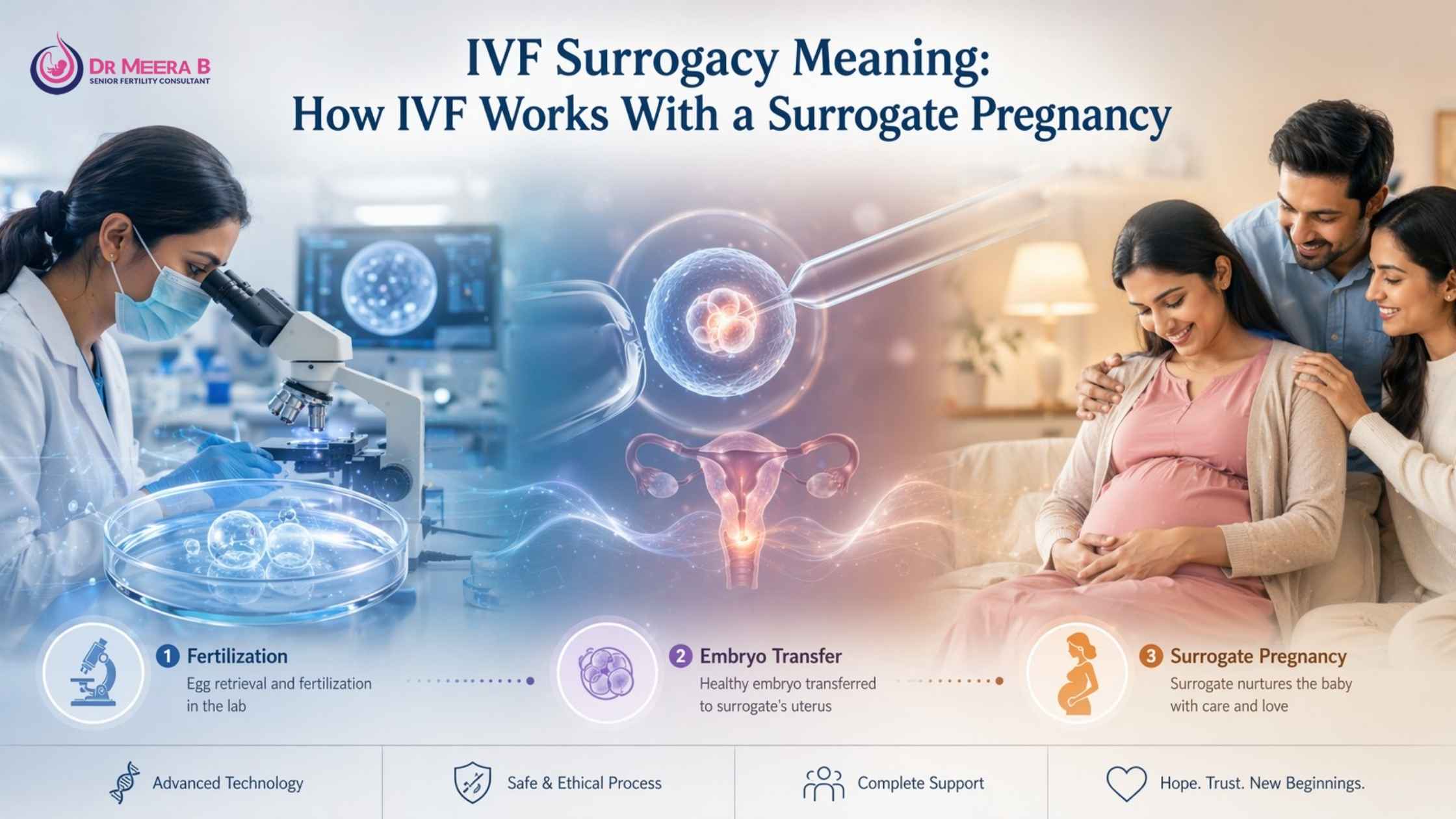
IVF Surrogacy Meaning: How IVF Works With A Surrogate Pregnancy
Across the world, fertility science has opened doors that were once unimaginable. According to global reproductive medicine reports, millions of babies have been born through IVF since the first IVF birth in 1978. Yet for some couples, carrying a pregnancy themselves may not be medically possible. In such cases, understanding the ivf surrogacy meaning becomes crucial. IVF surrogacy combines advanced reproductive medicine with compassionate collaboration, allowing intended parents to welcome a biological child through the help of a surrogate mother.
For couples seeking trustworthy medical guidance in Kerala, Dr Meera B, a highly experienced gynecologist and fertility specialist practicing at Aster PMF Hospital, Sasthamkotta, offers evidence-based consultation and treatment planning. With more than three decades of experience and international training in reproductive medicine at the renowned Bourn Hall Clinic in Cambridge, Dr Meera B provides couples with safe, ethical, and medically sound pathways toward parenthood.
What is ivf surrogacy?
Many prospective parents begin their fertility journey by asking a simple yet important question: what is ivf surrogacy? In medical terms, IVF surrogacy refers to a reproductive arrangement where embryos created through in vitro fertilization are transferred into the uterus of a surrogate who carries the pregnancy on behalf of the intended parents.
To understand the concept better, the phrase ivf surrogacy means combining assisted reproductive technology with surrogate gestation. Instead of the intended mother carrying the baby, another woman — the surrogate — carries the pregnancy until delivery.
This option is considered when:
- The intended mother has a medical condition that prevents pregnancy.
- The uterus has been surgically removed.
- Repeated IVF attempts have failed.
- Pregnancy poses serious health risks.
- Some single parents or couples require a gestational carrier.
Under the guidance of specialists like Dr Meera B, couples receive personalized evaluation to determine whether IVF surrogacy is medically appropriate and legally compliant within India’s regulations.
Understanding ivf surrogate meaning in reproductive medicine
The term ivf surrogate meaning refers to a woman who carries a pregnancy created using IVF technology for another individual or couple. In modern fertility practice, the most common form is gestational surrogacy, where the surrogate has no genetic connection to the baby.
This distinction is important. In traditional surrogacy, the surrogate’s own egg might be used. However, in modern reproductive medicine — especially in India — gestational surrogacy ivf is the widely practiced and medically recommended model.
In gestational surrogacy:
- The embryo is created using the intended parents’ egg and sperm, or donor gametes.
- The surrogate carries the pregnancy but is not genetically related to the baby.
- Medical monitoring ensures the pregnancy progresses safely.
Dr Meera B emphasizes that ethical surrogacy always prioritizes the safety of the surrogate and the intended parents while following established reproductive guidelines.
How the ivf surrogate pregnancy process works
The ivf surrogate pregnancy process involves several carefully coordinated medical and clinical steps. Each stage requires expert supervision to ensure optimal outcomes for both the surrogate and the intended parents.
Step-by-step overview
- Initial fertility consultation
A detailed medical consultation with Dr Meera B helps evaluate fertility history, medical conditions, and potential treatment plans. - Fertility testing and planning
Hormone tests, imaging studies, and reproductive evaluations help determine the best approach for IVF. - Egg retrieval and fertilization
Eggs are retrieved from the intended mother or donor and fertilized with sperm in the laboratory. - Embryo development
Fertilized embryos are cultured in specialized laboratory environments before transfer. - ivf embryo transfer surrogate
A healthy embryo is transferred into the surrogate’s uterus through a precise medical procedure. - Pregnancy monitoring
The surrogate undergoes regular medical monitoring to ensure a healthy pregnancy.
Each stage requires careful coordination between fertility specialists, embryologists, and medical teams. At Dr Meera B’s place of practice, advanced reproductive technologies help ensure that treatment is conducted using internationally accepted medical standards.
What happens during ivf embryo transfer surrogate procedure?
The ivf embryo transfer surrogate stage is one of the most critical moments in the entire fertility journey. During this procedure, a developed embryo is placed into the surrogate’s uterus using a thin catheter under ultrasound guidance.
Key characteristics of the procedure include:
- It is minimally invasive.
- Usually performed without anesthesia.
- Takes only a few minutes.
- Requires careful hormonal preparation of the surrogate.
After transfer, the surrogate continues hormone support and undergoes pregnancy testing approximately two weeks later to confirm implantation.
Gestational surrogacy ivf: why it is widely recommended
Among all surrogacy models, gestational surrogacy ivf is considered the safest and most ethically structured method in modern reproductive medicine.
Its advantages include:
- No genetic relationship between surrogate and child.
- Clearer legal frameworks in many countries.
- Higher medical predictability.
- Better emotional boundaries for all parties involved.
Specialists like Dr Meera B rely on comprehensive counseling to ensure intended parents understand both the medical and emotional aspects of surrogacy before proceeding.
How ivf pregnancy through surrogate helps families
For couples facing infertility challenges, an ivf pregnancy through surrogate can transform what once felt like an impossible dream into reality. Many families who were unable to conceive naturally have successfully welcomed children through this pathway.
Situations where this option may be considered include:
- Repeated miscarriage
- Congenital absence of the uterus
- Severe uterine scarring
- Serious medical risks during pregnancy
- Certain genetic or reproductive disorders
When guided by experienced fertility specialists, surrogacy is not simply a medical process — it becomes a carefully structured journey supported by science, compassion, and ethical responsibility.
The role of experience in surrogacy and IVF treatment
Choosing the right fertility expert is one of the most important decisions intended parents make. Fertility treatments involve multiple biological, emotional, and logistical factors that must be handled with care.
Dr Meera B brings more than 30 years of clinical experience in obstetrics, gynecology, and reproductive medicine. Her credentials include MBBS, DGO, DNB (O&G), MRCOG (UK), and FRCOG (UK). She also received training at the historic Bourn Hall Clinic in Cambridge — the birthplace of the world’s first IVF baby.
Today, patients from across Kerala and beyond consult her at Aster PMF Hospital, Sasthamkotta, where she evaluates fertility conditions, recommends scientifically proven treatments, and guides couples through advanced reproductive options including IVF and surrogacy.
Why couples choose consultation with Dr Meera B
When couples begin exploring fertility treatment options, accurate medical guidance becomes invaluable. Consulting with Dr Meera B offers several advantages:
- Three decades of clinical experience
- International training in reproductive medicine
- Evidence-based fertility treatment planning
- Personalized patient evaluation
- Compassionate counseling during complex fertility journeys
Her approach focuses on transparency, realistic expectations, and treatments that are medically appropriate for each patient’s unique situation.
About Dr Meera B
Dr Meera B is a senior gynecologist and fertility specialist with extensive experience in reproductive medicine. She graduated from Government Medical College Trivandrum and pursued post-graduate training at Government Medical College Kottayam. She became a Member of the Royal College of Obstetricians and Gynaecologists (MRCOG) in 2008 and was awarded Fellowship (FRCOG) in 2022.
Her training at Bourn Hall Clinic in Cambridge — the birthplace of the world’s first IVF baby — strengthened her expertise in IVF and assisted reproductive technologies. Today, she continues to help couples navigate infertility challenges with compassion and scientific precision.
How to consult Dr Meera B
Couples seeking guidance regarding IVF or surrogacy can schedule a consultation with Dr Meera B through the official website.
To book an appointment:
- Fill out the consultation form at https://drmeerab.com/contact/
- Call +91 9447145101 to request an appointment
- Send a WhatsApp message through the website interface
Dr Meera B’s team will coordinate the appointment and guide patients through the next steps of consultation and treatment planning.
For many couples struggling with infertility, understanding the true ivf surrogacy meaning is the first step toward hope. With expert guidance, ethical medical practices, and advanced reproductive science, IVF surrogacy continues to offer families a path toward the dream of parenthood.
Frequently Asked Questions About IVF Surrogacy
Many couples researching fertility treatments often ask what is ivf surrogacy and how it differs from traditional IVF treatment. In simple terms, ivf surrogacy meaning refers to a fertility method in which embryos created through in vitro fertilization are transferred to a surrogate who carries the pregnancy for the intended parents.
At Dr. Meera B’s fertility practice, the process begins with medical evaluation, fertility testing, and counseling to determine whether surrogacy is the most appropriate path. Once embryos are created using the intended parents’ or donors’ gametes, they are transferred into a carefully screened surrogate who will carry the pregnancy.
This approach offers hope for individuals who cannot safely carry a pregnancy due to medical conditions, previous pregnancy complications, or uterine issues.
The ivf surrogate pregnancy process involves several carefully coordinated steps that ensure safety for both the surrogate and the intended parents. First, fertility specialists perform medical assessments and fertility testing.
Eggs are retrieved from the intended mother or donor and fertilized with sperm in the laboratory. Once embryos are created and monitored for quality, the best embryo is selected for transfer into the surrogate’s uterus.
Dr. Meera B guides families through each stage of the ivf surrogate pregnancy process including embryo development, legal preparation, surrogate screening, and pregnancy monitoring.
The phrase ivf surrogate meaning refers to a pregnancy carried by a surrogate after embryos are created through IVF in a fertility lab. The surrogate does not contribute her eggs in most modern surrogacy programs.
Instead, embryos are created using eggs and sperm from the intended parents or donors, making the surrogate the gestational carrier rather than a genetic parent.
Dr. Meera B provides detailed consultation sessions explaining ivf surrogate meaning so intended parents understand the emotional, medical, and legal aspects of the process.
Gestational surrogacy ivf is the most common form of surrogacy used today. In this method, the surrogate carries an embryo created using IVF but does not have a genetic relationship to the child.
Traditional surrogacy, which is less commonly practiced today, involves the surrogate’s own egg. Gestational surrogacy ivf avoids genetic complications and legal uncertainties because the embryo typically comes from the intended parents or donors.
At Dr. Meera B’s clinic, gestational surrogacy ivf is handled with comprehensive fertility evaluation, surrogate screening, and continuous medical monitoring throughout pregnancy.
The ivf embryo transfer surrogate stage is one of the most critical moments in the entire surrogacy journey. During this step, a healthy embryo developed in the laboratory is transferred into the surrogate’s uterus using a precise medical procedure.
The procedure is painless and typically performed without anesthesia. After the ivf embryo transfer surrogate procedure, the surrogate undergoes hormonal support and monitoring to ensure successful implantation.
Dr. Meera B’s fertility team uses advanced embryo selection techniques and careful uterine preparation to improve implantation success rates.
Yes, ivf pregnancy through surrogate is often recommended when a woman cannot safely carry a pregnancy due to medical conditions such as uterine abnormalities, repeated IVF failures, or serious health risks.
Through ivf pregnancy through surrogate, embryos created through IVF are transferred into a surrogate who carries the pregnancy on behalf of the intended parents.
Dr. Meera B provides a structured care pathway that includes fertility testing, embryo development, surrogate selection guidance, and pregnancy monitoring to ensure the best possible outcome.
When people research fertility options, they often ask what ivf surrogacy means in practical terms. Essentially, ivf surrogacy means combining IVF technology with a surrogate pregnancy so that individuals who cannot carry a child can still become parents.
Understanding ivf surrogacy means exploring medical procedures, emotional considerations, and legal frameworks involved in the surrogacy journey.
Dr. Meera B supports intended parents with personalized fertility consultations, treatment planning, and compassionate guidance throughout every stage of the surrogacy process.
Choosing a fertility specialist is an important decision for intended parents considering surrogacy. Dr. Meera B offers comprehensive fertility care that includes advanced IVF treatment, surrogacy counseling, and patient-centered support.
Her clinic focuses on transparency, medical safety, and individualized treatment strategies tailored to each family’s needs.
With expertise in modern reproductive medicine, Dr. Meera B helps intended parents navigate every aspect of IVF and surrogacy with clarity, compassion, and medical excellence.
Comments are closed