
TSH levels in pregnancy: Normal range & what they mean
Nearly 2–3% of pregnant women worldwide are affected by thyroid dysfunction, and studies from India suggest that subclinical thyroid disorders may be even more common in pregnancy. This makes tsh level in pregnancy a critical marker that directly influences fertility outcomes, fetal brain development, and the overall course of pregnancy. Understanding how thyroid-stimulating hormone behaves during pregnancy is not just medical information—it is knowledge that empowers expecting mothers to protect their baby’s future.
At Dr Meera B’s place of practice, including her recent consultations at Aster PMF Hospital, Sasthamkotta, careful monitoring and interpretation of thyroid parameters form an essential part of pregnancy care. With over three decades of experience in obstetrics, gynecology, and reproductive medicine, Dr Meera B brings clinical depth, international training, and ethical medical judgment to every consultation.
What is TSH and why does it matter during pregnancy?
TSH, or thyroid-stimulating hormone, is produced by the pituitary gland and regulates how much thyroid hormone (T3 and T4) the thyroid gland releases into the bloodstream. During pregnancy, this balance becomes more delicate because maternal thyroid hormones support the baby’s neurological development, especially in the first trimester when the fetal thyroid is not fully functional.
Even mild deviations in serum tsh level during pregnancy can have consequences if left unrecognized. This is why obstetricians with strong endocrine awareness, like Dr Meera B, emphasize timely screening and evidence-based follow-up rather than reactive treatment.
How pregnancy changes thyroid physiology
Pregnancy introduces hormonal shifts that naturally alter thyroid function. Human chorionic gonadotropin (hCG), which rises sharply in early pregnancy, can suppress TSH levels. At the same time, increased estrogen raises thyroid-binding globulin, affecting circulating thyroid hormones.
- In early pregnancy, TSH may fall below non-pregnant reference values.
- Total T3 and T4 levels increase due to higher binding proteins.
- The thyroid gland works harder to meet maternal and fetal needs.
These physiological adaptations explain why pregnancy-specific reference values are essential and why relying on non-pregnant norms can lead to misinterpretation.
What is the normal TSH during pregnancy?
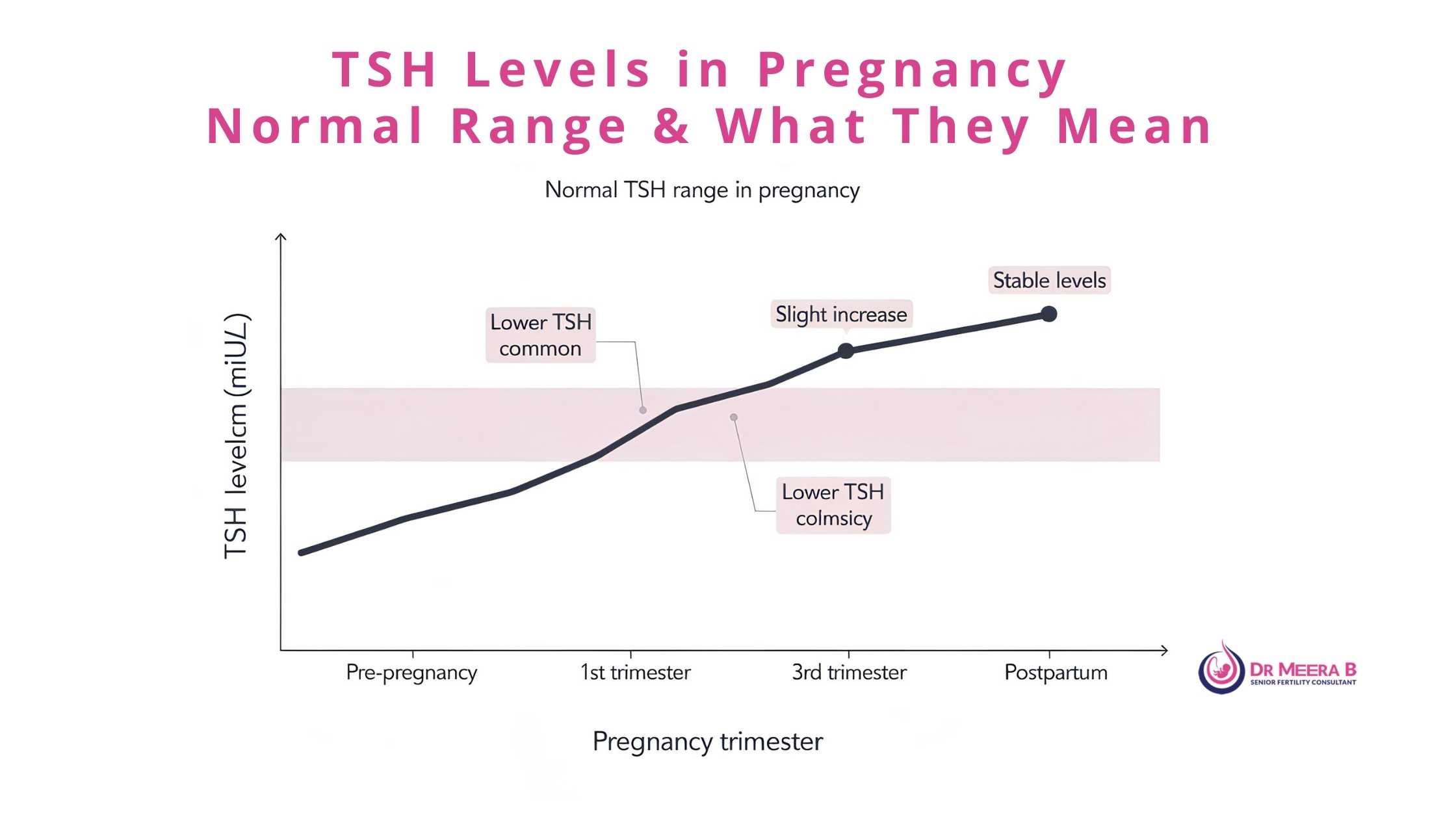
The concept of normal tsh during pregnancy differs from standard adult values. International and Indian clinical guidelines recommend trimester-specific reference ranges to ensure accurate assessment and avoid unnecessary anxiety or overtreatment.
| Trimester | Typical TSH reference range |
|---|---|
| First trimester | 0.1 – 2.5 mIU/L |
| Second trimester | 0.2 – 3.0 mIU/L |
| Third trimester | 0.3 – 3.0 mIU/L |
These values are commonly referred to as tsh levels in pregnancy by trimester and are widely accepted in clinical practice. However, Dr Meera B emphasizes that lab reference ranges, patient symptoms, antibody status, and obstetric history must all be interpreted together.
Understanding the pregnancy TSH range in real-world care
The pregnancy tsh range is not just a number on a report—it is a decision-making tool. A TSH value that is borderline high or low may require different management depending on:
- Previous history of thyroid disease
- Presence of thyroid antibodies
- History of infertility or pregnancy loss
- Coexisting medical conditions
With her training in reproductive medicine and IVF from Bourn Hall Clinic, Cambridge, Dr Meera B approaches thyroid balance as part of a larger fertility and pregnancy ecosystem, not as an isolated lab abnormality.
TSH test in pregnancy normal range and when testing is advised
The tsh test in pregnancy normal range is most meaningful when testing is done at the right time and for the right reasons. Universal screening is increasingly advocated, especially in regions like Kerala where thyroid disorders are relatively prevalent.
Testing is particularly important for women who:
- Have a family history of thyroid disease
- Have infertility or recurrent pregnancy loss
- Have symptoms such as fatigue, weight changes, or palpitations
- Are undergoing assisted reproductive treatments
At Dr Meera B’s place of practice, thyroid testing is integrated into preconception counseling and early antenatal care, ensuring that deviations are detected before they affect pregnancy outcomes.
What happens if TSH levels are abnormal?
Abnormal TSH values during pregnancy fall broadly into two categories: hypothyroidism (high TSH) and hyperthyroidism (low TSH). Both require careful, evidence-based management.
Untreated hypothyroidism has been associated with miscarriage, preeclampsia, anemia, and impaired neurodevelopment in the child. Hyperthyroidism, though less common, can increase risks of preterm birth and low birth weight.
Dr Meera B follows internationally accepted protocols, adjusting treatment cautiously and monitoring levels periodically to maintain a stable serum tsh level during pregnancy without exposing the mother or fetus to unnecessary risks.
Why expert guidance makes a difference
Thyroid management in pregnancy is not a one-size-fits-all approach. Overcorrection can be as harmful as under-treatment. This is where experience, judgment, and up-to-date knowledge matter.
Dr Meera B, MBBS, DGO, DNB (O&G), MRCOG (UK), FRCOG (UK), combines:
- Over 30 years of clinical experience
- International exposure to advanced reproductive medicine
- A patient-centric, ethical approach to care
Patients consulting her at Aster PMF Hospital, Sasthamkotta, and other places of practice benefit from individualized treatment pathways rather than protocol-driven shortcuts.
The cost of ignoring thyroid balance in pregnancy
Many women assume that feeling tired or gaining weight is “normal” in pregnancy and may delay evaluation. Unfortunately, missed or late diagnosis of thyroid imbalance can have lifelong implications for the child.
Early consultation with an experienced gynecologist ensures that small deviations do not escalate into preventable complications. Choosing expert care is not an expense—it is an investment in maternal confidence and fetal well-being.
About Dr Meera B
Dr Meera B is a senior gynecologist and fertility specialist based in Kollam, Kerala. A graduate of Govt Medical College, Trivandrum, with postgraduate training from Govt Medical College, Kottayam, she has further honed her expertise through MRCOG and FRCOG credentials from the UK.
Her advanced training in reproductive medicine and IVF at the renowned Bourn Hall Clinic, Cambridge, places her among a select group of Indian specialists with direct exposure to globally benchmarked fertility care.
To book an appointment for consultation with Dr Meera B, patients can fill and submit the form at https://drmeerab.com/contact/, call +91 9447145101, or send a WhatsApp message using the interface on the website. Dr Meera’s team will schedule the appointment and keep you informed.
Frequently Asked Questions: TSH Levels in Pregnancy
Thyroid hormones play a critical role in fetal brain and nervous system development, especially in early pregnancy when the baby depends entirely on the mother. Monitoring tsh level in pregnancy helps detect subtle thyroid imbalances that may not cause obvious symptoms but can still affect maternal health and pregnancy outcomes.
Doctors assess thyroid function using trimester-specific cut-offs rather than a single fixed value. In general, normal tsh during pregnancy is lower than in non-pregnant adults, as hormonal changes influence how the thyroid gland functions throughout gestation.
Thyroid-stimulating hormone levels naturally fluctuate as pregnancy progresses. Clinicians evaluate tsh levels in pregnancy by trimester to ensure that the values align with the physiological demands of each stage, particularly the first trimester when fetal dependence is highest.
A thyroid profile primarily checks how well the thyroid gland is responding to the body’s needs. Doctors interpret results against the tsh test in pregnancy normal range to decide whether further evaluation or treatment is required.
A consistently high or low serum tsh level during pregnancy may indicate hypothyroidism or hyperthyroidism. Early identification allows timely intervention, which is crucial to reduce risks such as miscarriage, preterm delivery, or growth issues in the baby.
Dr. Meera B offers individualized care that combines detailed evaluation of pregnancy tsh range with clinical symptoms, ultrasound findings, and follow-up testing. Her approach focuses on gentle dose adjustments, close monitoring, and clear guidance to support a healthy pregnancy for both mother and baby.
Comments are closed