
According to global fertility research, nearly 1 in 6 couples worldwide experience infertility, making assisted reproductive treatments increasingly important in modern medicine. When couples begin exploring solutions, one of the most common questions they encounter is IVF vs IUI. Understanding the differences between these two treatments can help couples make informed decisions about the most appropriate path to parenthood.
Choosing the right fertility treatment can feel overwhelming. With multiple medical options, emotional considerations, and financial implications, many couples struggle to determine which approach will give them the best chance of success. This is where experienced fertility specialists like Dr Meera B play a crucial role in guiding patients through evidence-based fertility treatment options tailored to their specific medical situation.
Dr Meera B is a highly respected gynecologist and fertility specialist with more than three decades of clinical experience. Holding prestigious qualifications including MBBS, DGO, DNB (O&G), MRCOG (UK), and FRCOG (UK), she has trained internationally at the renowned Bourn Hall Clinic in Cambridge, UK—the birthplace of the world’s first IVF baby. Today, she supports couples from India and abroad seeking effective fertility solutions at Dr Meera B’s place of practice, including Aster PMF Hospital, Sasthamkotta.
What is the difference between IVF vs IUI?
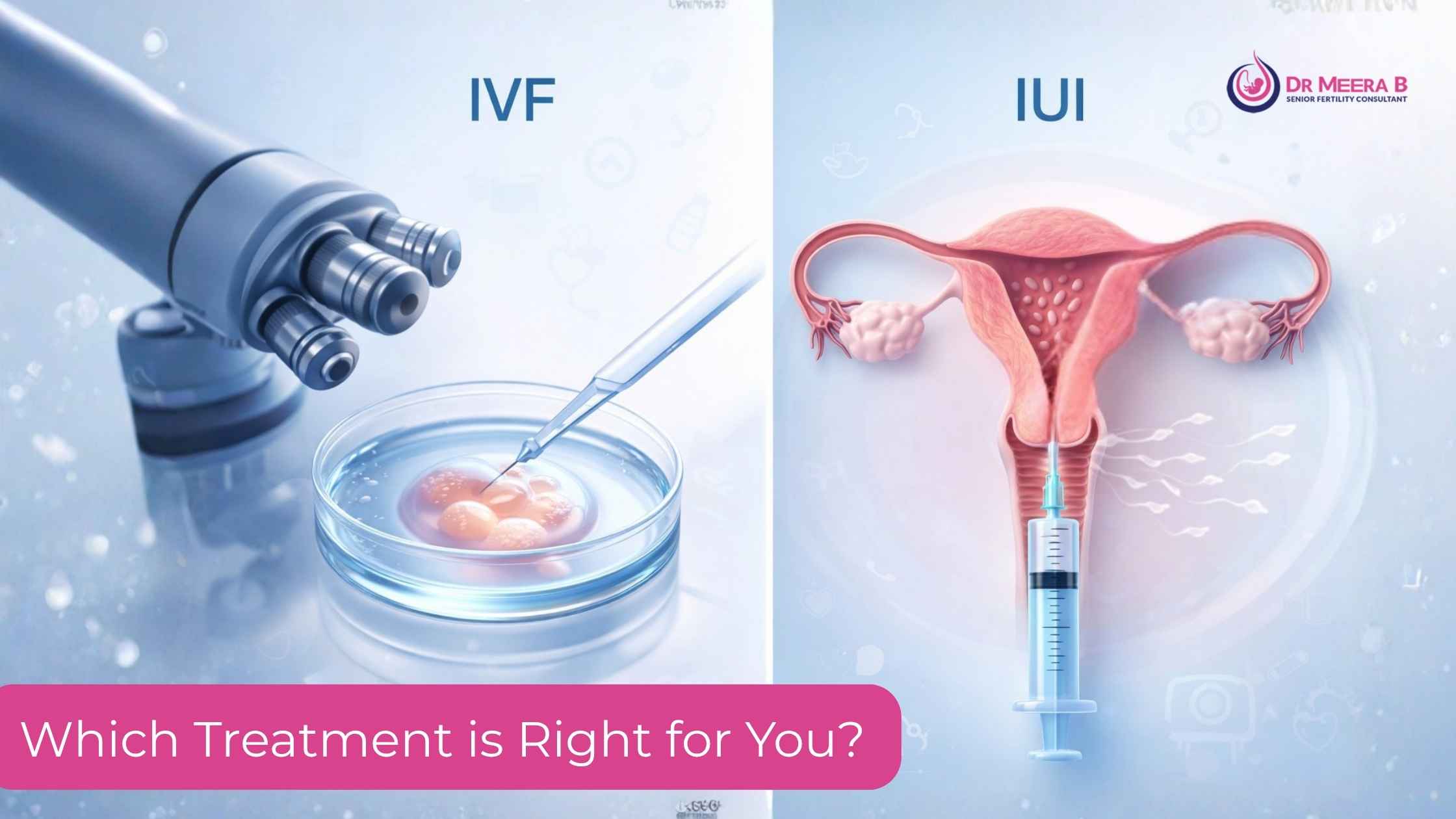
The main difference in IVF vs IUI lies in where fertilization occurs. In IUI, sperm is placed directly inside the uterus to increase the chances of natural fertilization. In IVF, fertilization occurs outside the body in a laboratory before the embryo is transferred to the uterus.
Both methods are scientifically validated fertility treatment options, but they serve different purposes depending on the couple’s medical diagnosis, age, fertility history, and reproductive health.
| Factor | IUI | IVF |
|---|---|---|
| Procedure complexity | Simple outpatient procedure | Advanced laboratory procedure |
| Where fertilization occurs | Inside the uterus | In the laboratory |
| Cost | Lower | Higher due to lab procedures |
| Success rates | Moderate | Higher in many conditions |
At Dr Meera B’s place of practice, couples receive a personalized fertility evaluation before deciding between these treatments. This ensures that each couple receives a solution based on medical evidence rather than guesswork.
Understanding the IUI success rate
The IUI success rate varies depending on several factors including age, underlying fertility conditions, and sperm quality. On average, the IUI success rate ranges between 10% and 20% per cycle for many couples.
However, outcomes can improve significantly when:
- The woman is under 35 years of age
- Ovulation induction medications are used appropriately
- Sperm quality is healthy
- Fertility conditions are mild
IUI is often recommended as a first-line treatment for couples facing:
- Unexplained infertility
- Ovulation disorders
- Cervical mucus issues
- mild male infertility treatment scenarios
Dr Meera B carefully evaluates reproductive health indicators such as ovarian reserve, hormonal balance, and semen parameters before recommending IUI. This evidence-based approach helps maximize the IUI success rate while avoiding unnecessary treatments.
IVF success comparison: Why IVF may offer higher success in certain cases
An IVF success comparison with IUI often shows that IVF can offer higher success rates, especially in more complex fertility conditions. Depending on age and medical factors, IVF success rates can range from 40% to 60% per cycle for younger women.
IVF is particularly beneficial when fertilization or implantation issues are suspected. Because fertilization occurs in a laboratory setting, specialists can monitor embryo development closely and transfer the healthiest embryo.
An IVF success comparison becomes especially important when couples experience:
- Blocked fallopian tubes
- Severe male infertility
- Endometriosis
- Repeated failed IUI cycles
- Advanced maternal age
At Dr Meera B’s place of practice, advanced reproductive technology available in partner facilities allows patients to undergo modern IVF protocols under expert supervision.
Which fertility treatment options are available today?
Modern reproductive medicine offers several fertility treatment options, allowing doctors to customize treatments based on individual needs. Instead of applying a one-size-fits-all approach, specialists develop treatment plans tailored to each couple’s diagnosis.
Common fertility treatment options include:
- Ovulation induction medications
- Intrauterine insemination (IUI)
- In vitro fertilization (IVF)
- Intracytoplasmic sperm injection (ICSI)
- Fertility preservation techniques
Dr Meera B emphasizes thorough diagnostic testing before recommending any procedure. This may include hormonal testing, ultrasound imaging, semen analysis, and reproductive health assessments.
Such comprehensive evaluation helps identify the root cause of infertility and ensures that couples pursue the most appropriate fertility treatment options from the beginning.
When is mild male infertility treatment recommended?
Male factors contribute to infertility in nearly 40% of couples. Fortunately, many cases fall under the category of mild male infertility treatment, which can often be addressed successfully using IUI.
Mild male infertility treatment may be considered when semen analysis reveals:
- Slightly reduced sperm count
- Mild motility issues
- Minor morphology abnormalities
During IUI, sperm is processed in the laboratory to concentrate the healthiest sperm before placing them directly into the uterus. This increases the probability of fertilization.
In cases where sperm parameters are more severely affected, IVF combined with ICSI may be recommended instead. Dr Meera B evaluates male fertility factors carefully before recommending the most appropriate treatment strategy.
How do PCOS fertility options influence treatment choice?
Polycystic ovary syndrome (PCOS) is one of the most common hormonal conditions affecting women of reproductive age. The availability of PCOS fertility options has significantly improved pregnancy outcomes for many women diagnosed with this condition.
PCOS fertility options may include:
- Lifestyle modification and weight management
- Ovulation induction medications
- IUI treatment
- IVF in complex cases
For many women with PCOS, ovulation induction combined with IUI may be effective. However, when ovulation remains irregular or multiple IUI attempts fail, IVF may provide better success rates.
Dr Meera B carefully tailors PCOS fertility options to each patient’s hormonal profile, ovarian response, and overall reproductive health. This individualized care greatly improves the chances of successful conception.
How Dr Meera B helps couples choose between IVF vs IUI
Choosing between IVF vs IUI requires careful medical judgment, accurate diagnosis, and realistic expectations. Dr Meera B combines decades of experience with modern reproductive science to guide couples through this important decision.
During consultation, she evaluates multiple factors including:
- Age of the woman
- Duration of infertility
- Previous pregnancy history
- Sperm quality
- Hormonal profile
- Reproductive anatomy
Based on these findings, she explains the expected outcomes of each treatment approach and helps couples understand the potential benefits and limitations of IVF vs IUI.
Couples often find reassurance in the clarity and transparency of her approach. Rather than rushing into advanced procedures, she focuses on recommending treatments that are medically justified and supported by clinical evidence.
Why expert guidance matters in fertility treatment
Fertility treatment is not just a medical procedure—it is an emotional journey. Many couples experience frustration, uncertainty, and anxiety while trying to conceive. Having an experienced fertility specialist guiding them through the process can make a profound difference.
Dr Meera B’s international training, decades of clinical expertise, and patient-focused care have helped countless couples pursue parenthood with confidence. Her approach combines advanced reproductive medicine with compassionate counseling and clear communication.
With the availability of advanced reproductive technology at Dr Meera B’s place of practice, including Aster PMF Hospital, Sasthamkotta, patients benefit from modern medical infrastructure alongside expert fertility guidance.
Book a consultation with Dr Meera B
If you are considering fertility treatment and wondering whether IVF vs IUI is the right choice for your situation, a professional consultation can provide the clarity you need.
To schedule a consultation with Dr Meera B:
- Fill out the appointment form at https://drmeerab.com/contact/
- Call or WhatsApp: +91 9447145101
Once your request is received, Dr Meera’s team will schedule your consultation and guide you through the next steps. Early evaluation and expert medical guidance can make a significant difference in achieving a successful pregnancy.
About Dr Meera B
Dr Meera B is an experienced gynecologist and reproductive medicine specialist based in Kollam, Kerala. She holds MBBS, DGO, DNB (O&G), MRCOG (UK), and FRCOG (UK) qualifications and has over thirty years of experience helping couples overcome fertility challenges.
She graduated from Government Medical College, Trivandrum and completed her post-graduation at Government Medical College, Kottayam. Her advanced training in reproductive medicine at Bourn Hall Clinic in Cambridge, UK has given her deep expertise in IVF and assisted reproductive technologies.
Today, Dr Meera B consults and supports patients seeking fertility solutions at her places of practice including Aster PMF Hospital, Sasthamkotta. Her mission is to provide scientifically proven fertility care that empowers couples with realistic hope and effective treatment pathways.
Comments are closed