
How to test & diagnose endometriosis
Endometriosis affects nearly 1 in 10 women of reproductive age worldwide, according to data published by the World Health Organization. Despite being so common, it often takes 7–10 years for a definitive diagnosis, leaving countless women living with pain, infertility, and emotional distress without clear answers. Understanding how to test & diagnose endometriosis early can be life-changing—and this is where expert, experience-driven care becomes invaluable.
This comprehensive guide is written to help women and families understand the diagnostic journey clearly, ethically, and scientifically. The insights shared here reflect the evidence-based clinical approach followed by a senior gynecologist with more than three decades of experience, who currently consults at other respected places of practice across Kerala.
What is endometriosis and why diagnosis is often delayed?
Endometriosis is a chronic gynecological condition where tissue similar to the uterine lining grows outside the uterus, commonly involving the ovaries, pelvic ligaments, bowel, or bladder. The challenge with endometriosis and diagnosis lies in the fact that symptoms can mimic other conditions such as pelvic inflammatory disease, irritable bowel syndrome, or even routine menstrual discomfort.
Many women normalize severe period pain for years. Others are treated symptomatically without identifying the underlying cause. This delay not only worsens pain but can also impact fertility outcomes—an area where timely diagnosis under an experienced specialist like Dr Meera B makes a measurable difference.
How can you be tested for endometriosis?
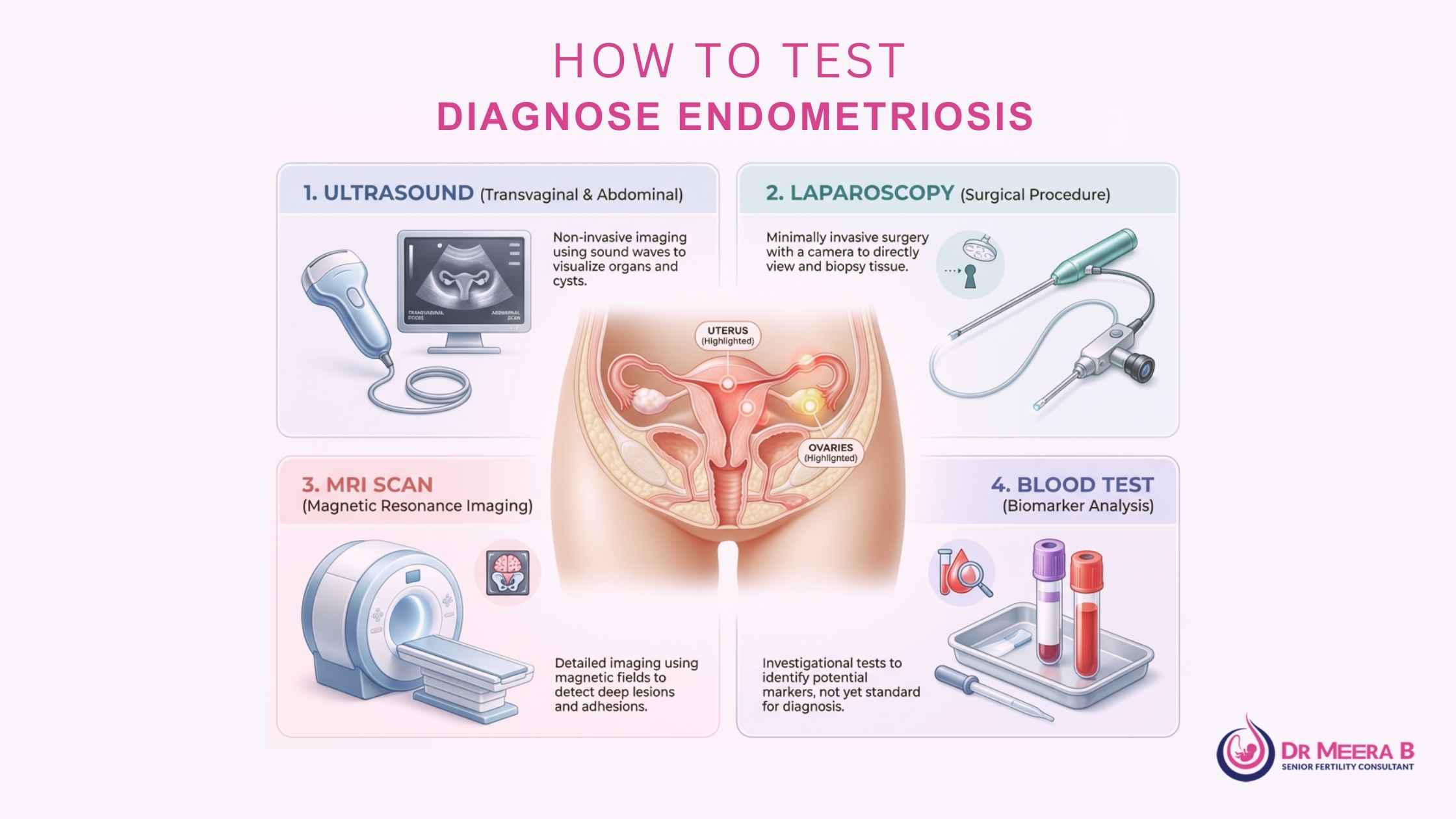
How can you be tested for endometriosis? The answer begins with a detailed clinical evaluation rather than a single test. There is no standalone blood test that confirms endometriosis. Diagnosis is a stepwise process that combines medical history, clinical examination, imaging, and—when required—minimally invasive surgery.
- Detailed symptom assessment including pain patterns and fertility history
- Pelvic examination by an experienced gynecologist
- Imaging studies such as ultrasound or MRI
- Diagnostic laparoscopy when clinically indicated
Dr Meera B’s approach emphasizes avoiding unnecessary procedures while ensuring that no red flags are overlooked—balancing accuracy with patient safety.
Can symptoms alone confirm endometriosis?
Symptoms raise suspicion but cannot confirm endometriosis on their own. Severe dysmenorrhea, chronic pelvic pain, pain during intercourse, bowel discomfort during periods, and unexplained infertility are all warning signs. However, symptom severity does not always correlate with disease extent.
This is why women who self-search how to test for endometriosis at home often feel frustrated. While symptom trackers and menstrual diaries are useful tools, they are not diagnostic. They serve best as supportive information that a specialist like Dr Meera B uses during evaluation.
Role of imaging in endometriosis diagnosis
Imaging helps identify advanced or deeply infiltrating disease but may miss early lesions. Transvaginal ultrasound performed by trained hands can detect ovarian endometriomas, while MRI provides detailed mapping in complex cases.
At Dr Meera B’s place of practice, imaging findings are always correlated clinically—ensuring that reports are interpreted in context, not in isolation.
What is laparoscopy and when is it needed?
The laparoscopy procedure endometriosis remains the gold standard for definitive diagnosis. It is a minimally invasive surgical procedure that allows direct visualization and, in many cases, treatment of endometriotic lesions.
Laparoscopy is not recommended for every woman with suspected endometriosis. It is advised when:
- Symptoms are severe and persistent despite treatment
- Imaging suggests advanced disease
- Infertility evaluation requires direct pelvic assessment
Dr Meera B’s international training in reproductive medicine ensures that laparoscopy is advised judiciously, always weighing benefits against risks.
Is there a way to test for endometriosis at home?
There is currently no scientifically validated way to test for endometriosis at home. Online symptom checkers and mobile apps can help women recognize patterns, but they cannot replace medical evaluation.
Women searching how to test for endometriosis at home are often seeking reassurance. The safest next step is a consultation with an experienced gynecologist who understands the nuances of the disease.
How is endometriosis managed after diagnosis?
Management is individualized and depends on symptoms, age, fertility goals, and disease severity. Diagnosis is not the end—it is the beginning of a tailored care plan.
While patients frequently ask how to treat endometriosis at home, it is important to clarify that lifestyle changes and pain coping strategies complement—but do not replace—medical care. Evidence-based management may include:
- Hormonal therapies to suppress disease activity
- Pain management strategies
- Surgical intervention when indicated
- Fertility-focused treatments for those trying to conceive
How to prevent endometriosis and reduce symptom progression
There is no guaranteed method for how to prevent endometriosis, but early diagnosis and appropriate treatment can slow progression and reduce complications.
Similarly, women seeking how to prevent endometriosis pain benefit most from:
- Early medical intervention
- Regular follow-ups with a specialist
- Evidence-backed pain management strategies
Dr Meera B’s long-term care philosophy focuses on minimizing disease impact while preserving quality of life.
Why expert diagnosis matters for fertility
Endometriosis is found in up to 40% of women with unexplained infertility. Accurate diagnosis plays a critical role in planning fertility treatment—especially in advanced reproductive care.
With training from the renowned Bourn Hall Clinic in Cambridge, UK, Dr Meera B integrates global best practices into local care, offering patients in Kerala access to world-class expertise at her place of practice.
About Dr Meera B
Dr Meera. B MBBS, DGO, DNB(O&G), MRCOG(UK), FRCOG(UK) is a senior gynecologist in Kollam with over 30 years of clinical experience. A graduate of Govt Medical College, Trivandrum, and post-graduate from Govt Medical College, Kottayam, she achieved MRCOG in 2008 and FRCOG in 2022.
Her expertise spans gynecology, reproductive medicine, and IVF, supported by international training at Bourn Hall Clinic—the birthplace of the world’s first IVF baby. Today, she consults at leading hospitals including Aster PMF Hospital, Sasthamkotta, offering ethical, evidence-based care to patients from Kerala and beyond.
How to book an appointment with Dr Meera B
If you suspect endometriosis or are struggling with unanswered symptoms, timely expert consultation can change your trajectory. To book an appointment with Dr Meera B:
- Fill and submit the consultation form at https://drmeerab.com/contact/
- Call or WhatsApp +91 9447145101
- Use the WhatsApp interface on the website to request an appointment
Dr Meera’s team will coordinate and confirm your consultation promptly, ensuring continuity of care at her place of practice.
Frequently Asked Questions: How to Test & Diagnose Endometriosis
How can you be tested for endometriosis is a common concern, and the process usually begins with a detailed clinical consultation. Dr. Meera B evaluates symptoms, menstrual history, pain patterns, and fertility concerns, followed by a pelvic examination and imaging when required. Testing is stepwise and individualized rather than based on a single test.
Endometriosis and diagnosis involve correlating symptoms with clinical findings and imaging results. Dr. Meera B focuses on ruling out other causes of pelvic pain while identifying signs that point strongly toward endometriosis, ensuring diagnosis is accurate, ethical, and evidence-based.
The laparoscopy procedure endometriosis is considered the gold standard for confirmation, but it is not advised for every patient. Dr. Meera B recommends it only when symptoms are severe, imaging suggests advanced disease, or fertility outcomes may be affected, ensuring benefits clearly outweigh risks.
There is currently no medically validated method for how to test for endometriosis at home. Symptom tracking can help women recognize patterns, but confirmation requires expert evaluation. Dr. Meera B advises against relying solely on online tools for diagnosis.
How to treat endometriosis at home should always be understood as supportive care, not a replacement for medical treatment. Lifestyle measures, pain coping strategies, and stress reduction may complement therapy prescribed by Dr. Meera B, but they do not eliminate the disease itself.
While there is no guaranteed method for how to prevent endometriosis entirely, early diagnosis and appropriate treatment can slow progression. Dr. Meera B emphasizes timely intervention, regular follow-ups, and individualized care to reduce long-term impact.
How to prevent endometriosis pain involves a structured medical approach rather than short-term remedies. Under Dr. Meera B’s guidance, pain prevention focuses on accurate diagnosis, appropriate medical therapy, and monitoring, which together help improve daily functioning and quality of life.
Comments are closed