
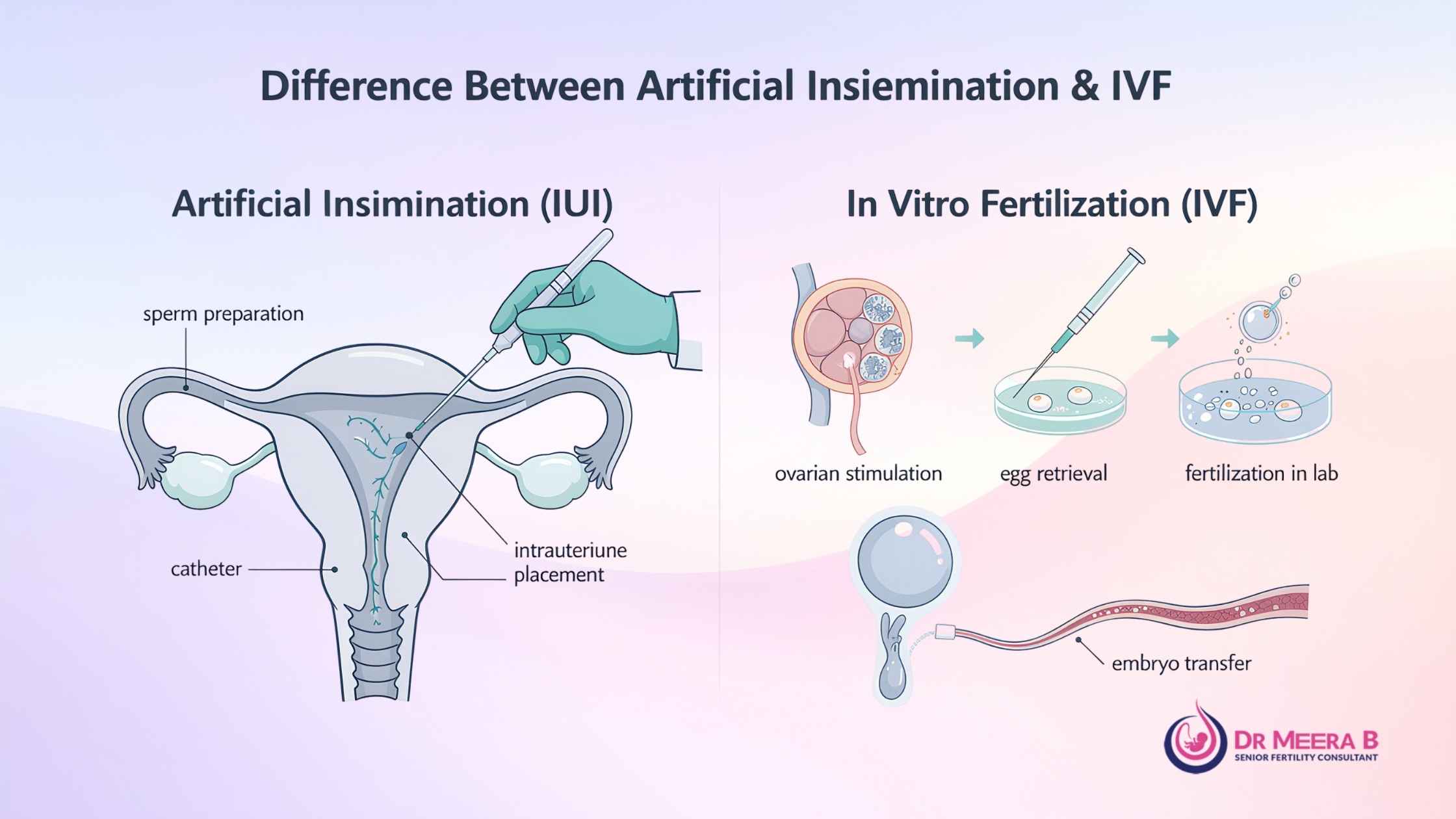
Difference between Artificial Insemination & IVF
Globally, infertility affects nearly 1 in 6 couples at some point in their reproductive lives, according to widely published public health data. With the increasing awareness and success of assisted reproductive technologies, understanding the Difference Between Artificial Insemination & IVF has become crucial for couples planning their fertility journey. While both treatments aim to help achieve pregnancy, they differ significantly in complexity, indications, success rates, and emotional investment.
Under the guidance of Dr Meera B, a highly experienced gynecologist and fertility expert in Kollam, couples receive clear, ethical, and evidence-based advice to choose the treatment that best aligns with their medical needs and personal circumstances. Her consultations at Dr Meera B’s place of practice, including Aster PMF Hospital, Sasthamkotta, have helped countless couples make informed decisions without confusion or unrealistic promises.
What is artificial insemination and how does it work?
Artificial insemination is one of the simplest forms of assisted reproduction. In this method, prepared sperm is placed directly into the female reproductive tract around the time of ovulation, increasing the chances of fertilization occurring naturally inside the body. This approach is often associated with artificial fertilization, a broad term that describes assisted techniques supporting natural conception.
This process relies on invivo fertilisation, meaning fertilization happens within the woman’s body rather than in a laboratory. Artificial insemination is commonly advised for:
- Mild male factor infertility
- Unexplained infertility of short duration
- Ovulatory disorders that respond to medication
- Couples seeking a less invasive first-line option
Dr Meera B carefully evaluates hormonal profiles, ovulation patterns, sperm parameters, and overall reproductive health before recommending artificial insemination, ensuring the approach is medically justified and ethically sound.
What is IVF and how is it different?
In vitro fertilization, commonly known by its abbreviation IVF, is a more advanced assisted reproductive technology. Another term for in vitro fertilization often used in patient education is “test-tube baby treatment,” though modern IVF is far more sophisticated and refined than the term suggests.
IVF involves stimulating the ovaries to produce multiple eggs, retrieving these eggs, fertilizing them with sperm in a laboratory, and then transferring one or more embryos into the uterus. For those wondering what is ivf pregnant, it simply means achieving pregnancy following embryo transfer during an IVF cycle.
IVF is usually recommended when:
- Fallopian tubes are blocked or damaged
- Severe male factor infertility is present
- Endometriosis affects fertility
- Previous treatments such as artificial insemination have failed
- Advanced maternal age reduces natural conception chances
IVF and IUI: how are they connected yet different?
Patients often encounter confusion when comparing ivf and iui. While both are assisted reproductive treatments, IUI (intrauterine insemination) is a form of artificial insemination, whereas IVF is a laboratory-based fertilization technique.
Dr Meera B emphasizes that IUI is not a weaker version of IVF, nor is IVF always the “next step” by default. Each method has its rightful place depending on diagnosis, duration of infertility, age, and prior treatment outcomes.
| Aspect | Artificial Insemination (IUI) | IVF |
|---|---|---|
| Fertilization site | Inside the body | Laboratory |
| Complexity | Low | High |
| Cost | Lower | Higher |
| Success rate | Moderate per cycle | Higher per cycle |
Why expert guidance matters in choosing the right treatment
One of the biggest pain points couples face is uncertainty—choosing the wrong treatment can lead to emotional exhaustion, financial strain, and loss of valuable time. This is where Dr Meera B’s three decades of experience make a measurable difference.
Having trained in Reproductive Medicine and IVF at the internationally renowned Bourn Hall Clinic in Cambridge, UK, Dr Meera B brings globally respected protocols into her clinical decision-making. Every recommendation she makes is based on proven outcomes, established guidelines, and individual patient assessment rather than generalized success stories.
Where treatment happens after consultation
After a detailed consultation with Dr Meera B, treatments such as artificial insemination or IVF are carried out at Dr Meera B’s place of practice, including advanced hospital facilities where the required technology, laboratories, and embryology support are available. This ensures patients benefit from modern infrastructure without compromising on personalized medical oversight.
About Dr Meera B
Dr Meera B, MBBS, DGO, DNB (Obstetrics & Gynaecology), MRCOG (UK), FRCOG (UK), is a senior gynecologist and fertility specialist with over thirty years of clinical experience. A graduate of Govt Medical College, Trivandrum, and post-graduate from Govt Medical College, Kottayam, she has been a trusted name in women’s health and fertility care in Kollam and beyond.
Her achievement as a Member of the Royal College of Obstetricians and Gynaecologists in 2008 and Fellowship in 2022 reflects her continued commitment to excellence. Patients consulting her at Aster PMF Hospital, Sasthamkotta, value her clarity, transparency, and ethical approach to fertility treatment.
Taking the next step
If you are unsure whether artificial insemination or IVF is right for you, delaying expert advice may cost you precious reproductive time. Early, accurate evaluation can make a significant difference in outcomes.
To book an appointment for consultation with Dr Meera B, you may fill and submit the form at https://drmeerab.com/contact/, call +91 9447145101, or send a WhatsApp message using the interface on the website. Dr Meera’s team will schedule your appointment and keep you informed every step of the way.
Frequently Asked Questions: Difference Between Artificial Insemination & IVF
The key difference lies in where fertilization happens. In artificial insemination, sperm is placed directly into the uterus to support natural conception inside the body, often referred to as artificial fertilization. In IVF, eggs and sperm are combined in a laboratory, and the resulting embryo is transferred to the uterus. Dr. Meera B helps couples choose the most suitable option based on diagnosis, age, and fertility history.
IVF involves stimulating the ovaries, retrieving eggs, fertilizing them in a controlled lab environment, and then transferring a healthy embryo into the uterus. This lab-based process is also known clinically as invivo fertilisation when implantation and pregnancy continue naturally in the body under expert medical care.
The phrase what is ivf pregnant commonly refers to achieving pregnancy through IVF treatment. Once implantation occurs, an IVF pregnancy progresses just like any natural pregnancy. Under Dr. Meera B’s supervision, patients receive continuous monitoring and support to ensure a healthy journey from embryo transfer to delivery.
Choosing between ivf and iui depends on factors such as age, sperm quality, tubal health, duration of infertility, and previous treatment outcomes. Dr. Meera B follows an individualized approach, recommending IUI for milder fertility issues and IVF for more complex or long-standing challenges.
Yes, another term for in vitro fertilization is commonly used in medical literature and patient education to describe the same process of fertilizing eggs outside the body and transferring embryos into the uterus.
Artificial insemination is often suitable for couples with unexplained infertility, mild male factor issues, or cervical factors. Dr. Meera B carefully evaluates hormonal health, ovulation patterns, and semen parameters before recommending this less invasive fertility solution.
Beyond clinical expertise, Dr. Meera B emphasizes emotional reassurance, clear communication, and realistic expectations. Whether patients choose insemination or IVF, her approach focuses on compassionate care, transparency in treatment planning, and continuous guidance throughout the fertility journey.
Comments are closed